إعـــــــلان

Collapse
No announcement yet.

قالوا عن المرأة ويا ليتهم ما قالوا

Collapse
X
 
  • Filter
  • الوقت
  • Show
Clear All
new posts

  • [frame="13 98"]
    Chapter IV
    Part 1


    Muslim headscarves

    Niqab
    Introduction
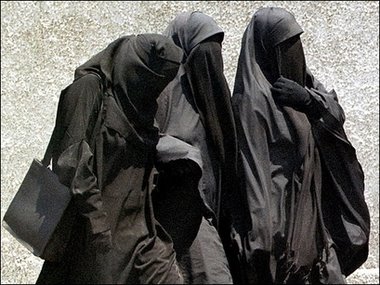

    A woman in niqab
    Niqab is different from [COLOR=window************************]hijab[/COLOR]. Hijab refers to covering everything except the hands and face. Niqab is the term used to refer to the piece of cloth which covers the face and women who wear it usually cover their hands also. It is worn by many Muslim women across Saudi Arabia and the Indian subcontinent and is worn by many women in the West.
    Historically, the veiling of the face was practised by many cultures before Islam and scholars say the adoption of its practice by Muslims was part of fitting into the society.
    Although the majority of scholars agree that hijab is obligatory, only a minority of them say that the niqab is.
    The scholars who do say it is obligatory are further divided by exactly what they believe needs to be covered. Some say that the eyes may be left unconcealed, while others say that everything must be concealed.
    However, those scholars who rule that niqab is not an obligation do not necessarily oppose those who choose to wear it.
    The most authentic ruling according to the majority of scholars is that it is not necessary and, unlike hijab, there is no sin if it is not worn. Some of these scholars state that wearing the niqab as an act of extra piety, provided they do not believe it is an obligation, will be rewarded.
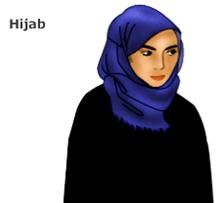

    The word hijab comes from the Arabic for veil and is used to describe the headscarves worn by Muslim women. These scarves come in myriad styles and colours. The type most commonly
    worn in the West is a square scarf that covers the head and neck but leaves the face clear.
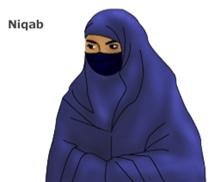


    The niqab is a veil for the face that leaves the area around the eyes clear. However, it may be worn with a separate eye veil. It is worn with an accompanying headscarf.
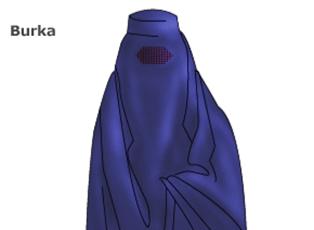


    The burka is the most concealing of all Islamic veils. It covers the entire face and body, leaving just a mesh screen to see through.
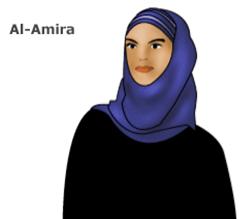


    The al-amira is a two-piece veil. It consists of a close fitting cap, usually made from cotton or polyester, and an accompanying tube-like scarf.
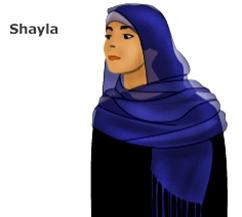


    The shayla is a long, rectangular scarf popular in the Gulf region. It is wrapped around the head and tucked or pinned in place at the shoulders.
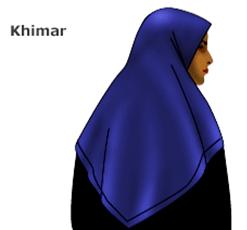


    The khimar is a long, cape-like veil that hangs down to just above the waist. It covers the hair, neck and shoulders completely, but leaves the face clear.
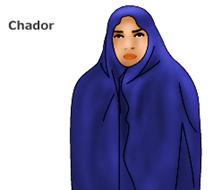


    The chador, worn by many Iranian women when outside the house, is a full-body cloak. It is often accompanied by a smaller headscarf underneath.
    The case for niqab
    Evidence for the obligation of niqab
    There are only a few references to veiling in the hadith and most of these actually refer to the khimar, which is restricted linguistically to head covering. The covering of the face is only mentioned in three hadith and never by the command of the [COLOR=window************************]Prophet Muhammad[/COLOR]. In fact, in one hadith, the companions of the Prophet Muhammad are even surprised at one woman's wearing of the niqab during her time of bereavement.
    The main evidence from scholars who believe that niqab is obligatory comes from these verses of the Qur'an.
    O Prophet! Tell thy wives and daughters, and the believing women, that they should cast their outer garments over their persons (when abroad): that is most convenient, that they should be known (as such) and not molested. And Allah is Oft- Forgiving, Most Merciful.
    Qur'an 33:59
    Scholars, such as Imam Abul A'la Mawdudi from the Indian subcontinent, suggest that these verses refer to covering the entire body, including the face and hands. The order 'cast their outer garments' in Arabic is similar to phrase 'draw together'. Scholars say that as a result of this verse, the women at the time of the Prophet drew together their garments over their entire body, including the face.
    One hadith that is used as evidence for this is:
    Narrated 'Aisha (wife of Prophet Muhammad): The Messenger of God, may the peace and blessings of God be upon him, used to offer the Fajr prayer and some believing women covered with their veiling sheets used to attend the Fajr prayer with him and then they would return to their homes unrecognized.
    Bukhari
    This hadith has been dated some time after verse 33:59 was revealed. Proponents of the niqab say that this hadith shows that the women during the time of the Prophet were not recognisable and hence they must have worn niqab.
    However, other scholars have argued that their faces were unrecognisable because it was dark, not because they were covered up. It is interesting to note that Aisha says 'some' women, and not all. Furthermore she refers to the early-morning prayer and not to any other. It would certainly make it more difficult to see who individuals were if they were dressed in cloaks before sunrise.
    In addition, they have argued that the order 'cast their outer garments over their persons' has been misunderstood. They say that the word 'face' has not been indicated in the Arabic, and it would therefore be wrong to extend the meaning.
    Other proponents of the niqab use this Qur'anic verse for evidence for the niqab.
    ...And when ye ask (the Prophet's wives) for anything ye want, ask them from before a screen: that makes for greater purity for your hearts and for theirs.
    Qur'an 33:53
    The wives of the Prophet were indeed required to wear the niqab by this Qur'anic verse. This is because the special status they had meant they had to be kept clear from all gossip and slander. Scholars say that if the wives of the Prophet, as the best of feminine examples, were required to wear niqab, then the ruling falls on all women.
    However, earlier on in the same chapter, the Qur'an also very clearly states that the Prophet's wives were not similar to other women.
    O Wives of the Prophet! You are not like any of the other women.
    33:32
    Most scholars are in agreement that the verse about the screen, or concealing of the face, is only obligatory on the wives of the Prophet. They say the verses are a clear indication that the wives of the Prophet are much more restricted in their movement due to their political position, and that their code of conduct does not constitute a code of conduct for women in general.
    The case against niqab
    Evidence against the obligation of niqab
    Most scholars, including the four main schools of Islamic jurisprudence, hold the view that niqab is not an obligation.
    They cite a number of references for this opinion.
    Say to the believing men that they should lower their gaze and guard their modesty: that will make for greater purity for them: And Allah is well acquainted with all that they do.
    And say to the believing women that they should lower their gaze and guard their modesty; that they should not display their beauty and ornaments except what (must ordinarily) appear thereof...
    24:30-31
    According to the majority of contemporary scholars 'what is apparent of it' refers to the hands and face.
    Another scholar, Shaykh Kutty, a senior lecturer and an Islamic scholar at the Islamic Institute of Toronto, Ontario, Canada suggests that because God asks both men and women to lower their gaze, it suggests their faces are visible, otherwise there would be no sense in it.
    Scholars holding this view also state that it is well accepted by all scholars that the Prophet categorically forbade people from covering their faces or hands during hajj, the pilgrimage to Mecca. If it was necessary that the hands and face be covered at all times, he would not have stated its impermissibility during one of the most sacred points of a person's life.
    It is also generally held by the majority of scholars, including those that believe niqab is obligatory, that covering the face during the five daily prayers is also prohibited.
    Another strong indication that niqab is not an obligation is presented in this hadith.
    Abdullah bin Abbas reports that the Prophet was riding a camel with Al-Fadhl, Abdullah's brother, behind him. A beautiful woman came to ask the Prophet about the Hajj of her father. Al Fadhl began to stare at her; her beauty impressed him a lot. The Prophet (peace be upon him) having noticed this while Al Fadhl was busy looking, put his hand behind and turned his face away from her hither and thither as she went along with them. Al Abbas said to the Prophet, "you are twisting the neck of your nephew!" The Prophet replied, "I noticed that both the boy and the girl were young; and I feared that Satan may intervene".
    Tirmidhi and Bukhari
    Scholars argue that the Prophet controlled the boy Al Fadhl's gaze, but didn't mention the fact that the woman was not covering her face. As a rule, anything that Prophet Muhammad stays silent about is tacit approval. This hadith would seem to indicate strongly that niqab is not obligatory.

    [/frame]

    هنـــــــــــــا

    îن îëéىهْ نçمùهْ?


    • [frame="13 98"]

      Scholars in the west
      Obligation vs recommendation
      Some contemporary scholars have gone further in their rulings about the niqab in the West. Although they may agree with its practice in Muslim countries, they say that it is harmful in the West and should therefore be avoided.
      Shaykh Darsh, a prominent UK scholar, did not believe that the niqab was necessary, or even recommended by the Prophet for women to wear. But if you were going to argue that niqab was a recommended act, he explained his opinion for wearing niqab in this country in the following way:
      · Some people believe that niqab is recommended (sunnah)
      · Everybody believes that inviting people to Islam (da'wah) is obligatory (fardh)
      · The niqab is often a very significant barrier to da'wah in the West where the concept of face covering has never been known
      · If a recommended act is a barrier to an obligatory act, one must not sacrfice the fardh for the sunnah
      Shaykh Nuh Keller, a Jordanian Shafi'i scholar and translator of Reliance of the Traveller, has put forward a similar argument for women in the West. He says that women should not wear niqab in the West because it can lead to harassment and act as a barrier to inviting people to Islam.
      A question of choice
      Freedom of choice
      Although the much stronger scholarly opinion holds that the niqab is not an obligation in Islam, it is appreciated that there is an opinion which believes it is. Differences in opinion are respected and celebrated, which is why a follower of one of these opinions will rarely say the other is completely wrong, or haram.
      Niqab has a place in Islam, since the Prophet's wives were required to wear them. In today's con************************, many women attempt to emulate the best of women to bring themselves closer to God.
      [/frame]

      هنـــــــــــــا

      îن îëéىهْ نçمùهْ?


      • [frame="13 98"]


        Hijab
        Introduction


        A girl studying the Qur'an
        Hijab is an Arabic word meaning barrier or partition.
        In Islam, however, it has a broader meaning. It is the principle of modesty and includes behaviour as well as dress for both males and females.
        The most visible form of hijab is the head covering that many Muslim women wear. Hijab however goes beyond the head scarf. In one popular school of Islamic thought, hijab refers to the complete covering of everything except the hands, face and feet in long, loose and non see-through garments. A woman who wears hijab is called Muhaajaba.
        Muslim women are required to observe the hijab in front of any man they could theoretically marry. This means that hijab is not obligatory in front of the father, brothers, grandfathers, uncles or young children.
        Hijab does not need to be worn in front of other Muslim women, but there is debate about what can be revealed to non-Muslim women.
        Modesty rules are open to a wide range of interpretations. Some Muslim women wear full-body garments that only expose their eyes. Some cover every part of the body except their face and hands. Some believe only their hair or their cleavage is compulsory to hide, and others do not observe any special dress rules.
        In the English speaking world, use of the word hijab has become limited to mean the covering on the head of Muslim woman. However, this is more accurately called a khimaar. The khimaar is a convenient solution comprising usually one, but sometimes two pieces of cloth, enabling Muslim women to cover their hair, ears and neck while outside the home.
        Hijab, in the sense of veiling, can also be achieved by hanging a curtain or placing a screen between women and men to allow them to speak to each other without changing dress. This was more common in the early days of Islam, for the wives of the Prophet Muhammad.
        Hijab in the Qur'an
        What the Qur'an says about the veil and modesty
        The [COLOR=window************************]Qur'an[/COLOR] makes a few references to Muslim clothing, but prefers to point out more general principles of modest dress.
        Say to the believing men that they should lower their gaze and guard their modesty: that will make for greater purity for them: And Allah is well acquainted with all that they do.
        24:30
        And say to the believing women that they should lower their gaze and guard their modesty; that they should not display their beauty and ornaments except what (must ordinarily) appear thereof; that they should draw their veils over their bosoms and not display their beauty except to their husbands, [a list of relatives], [household servants], or small children who have no sense of the shame of sex; and that they should not strike their feet in order to draw attention to their hidden ornaments. And O ye Believers! turn ye all together towards Allah, that ye may attain Bliss.
        24:31
        Both men and women are commanded to lower their gaze and "guard their modesty".
        The most basic interpretation of "guard their modesty" is to cover the private parts, which includes the chest in women ("draw their veils over their bosoms"). However, many scholars interpret this injunction in a more detailed way and use Hadith (recorded sayings of the Prophet Muhammad) to support their views.
        Zeenah (ornaments) is another word with numerous meanings. It has been interpreted to mean body parts, beauty, fine clothes or literal ornaments like jewellery. (The same word is used in chapter 7:31 - "O Children of Adam! wear your beautiful apparel at every time and place of prayer...")
        The jewellery interpretation is supported by the instruction to women not to stamp their feet to draw attention to themselves. It used to be the practice among Arabian women to wear ankle chains to attract men.
        The word translated here as veils is khumur, plural of khimaar. According to scholars, the word khimaar has no other meaning than a type of cloth which covers the head. Muslim scholars point out that men's turbans are sometimes called khumur as well.
        Women during the time of Muhammad did wear the khimaar, but would wear it tied behind so their neck and upper chest were visible. This verse is therefore an order that the khimaar now be drawn over the chest, so that the neck and chest were not bare.
        According to most scholars, the khimaar is obligatory for Muslim women.
        The phrase "what must ordinarily appear thereof" has been interpreted in many different ways. Among Muslims who take the word zeenah (ornaments) to refer to body parts, a popular interpretation of this phrase is that women should only show the body parts that are necessary for day-to-day tasks. This is usually taken to be the face and the hands.
        Some scholars recommend hiding everything but the eyes. The style of burqa worn by Afghan women even hides the eyes. Muslims who oppose full concealment say that if Allah wanted women to hide their entire bodies, there would have been no need to tell male Muslims to lower their gaze.
        But "what must ordinarily appear thereof" could be understood as meaning the parts of the body that are shown when wearing normal (modest) dress, with the definition of normal dress deliberately left up to the believers' particular time and culture. This could explain why the Qur'an is not more specific: if God had wanted to, he could have listed the acceptable body parts in as much detail as the list of exceptions to the rule.
        Some scholars interpret "what must ordinarily appear thereof" to mean that if a woman exposes part of her body by accident, she will be forgiven. All agree that women will not be punished for breaking the rules if some emergency forces them to do so.
        Cast their outer garments over their persons
        O Prophet! Tell thy wives and daughters, and the believing women, that they should cast their outer garments over their persons (when abroad): that is most convenient, that they should be known (as such) and not molested. And Allah is Oft- Forgiving, Most Merciful.
        33:59
        This verse is directed to all Muslim women. An alternative translation is "they should lengthen their garments".
        The word translated here as "outer garments" is jalabib, the plural of jilbab. But it does not necessarily refer to the present day garment known as jilbab. Translators usually represent the word jalabib with general terms like cloaks or outer garments.
        The two most common scholarly interpretations of jilbab are a travelling coat or cloak and a sheet-like full body garment similar to the modern jilbab. Some insist that the Qur'anic meaning of jilbab is identical to the present day garment. Others maintain that today's garment was developed as late as 1970 by the Muslim Brotherhood in Egypt.
        The verse also indicates that the purpose of dressing this way is that women are recognised as Muslims and not harassed. It was not very safe for women to go out during this time when they could be mistaken for prostitutes or assaulted.
        Elderly women
        The rules are relaxed for elderly women:
        Such elderly women as are past the prospect of marriage - there is no blame on them if they lay aside their (outer) garments, provided they make not a wanton display of their beauty: but it is best for them to be modest: and Allah is One Who sees and knows all things.
        24:60
        General rules
        The Qur'an gives these general rules, which may help in understanding how to interpret dress and other rules in modern times.
        O ye Children of Adam! We have bestowed raiment upon you to cover your shame, as well as to be an adornment to you. But the raiment of righteousness,- that is the best. Such are among the Signs of Allah, that they may receive admonition!
        7:26
        So clothing does not have to be drab: it is all right for both sexes to use clothing to enhance beauty as well as to cover nakedness. The most important thing is to be modest and righteous.


        [/frame]

        هنـــــــــــــا

        îن îëéىهْ نçمùهْ?


        • [frame="13 98"]


          History
          The Prophet's family
          Muslims in their first century at first were relaxed about female dress. When the son of a prominent companion of the Prophet asked his wife Aisha bint Talha to veil her face, she answered, "Since the Almighty hath put on me the stamp of beauty, it is my wish that the public should view the beauty and thereby recognized His grace unto them. On no account, therefore, will I veil myself."
          Women in the Muslim World, ed. Lynn Reese, 1998
          As Islam reached other lands, regional practices, including the covering of the faces of women, were adopted by the early Muslims. Yet it was only in the second Islamic century that the face veil became common, first used among the powerful and rich as a status symbol.
          A screening curtain
          When the Qur'an first mentioned the concept of hijab, it was not as a veil or headscarf. Hijab was used in the con************************ of a barrier or screen as in this Qur'anic verse:
          (...) And when ye ask (the Prophet's wives) for anything ye want, ask them from before a screen: that makes for greater purity for your hearts and for theirs.
          33:53
          Taken in historical con************************, this verse seems to have been primarily intended to give the Prophet's wives some protection against nuisance visitors and people who were looking for gossip about them.
          Gossip and slander were a great concern at the time the verses relating to hijab were revealed. One set of verses (24:1 onwards) came immediately after the Prophet's wife Aisha was accused and acquitted of adultery.

          Awrah
          The Arabic word awrah refers to the parts of the body which must be covered with clothing. Awrah is any part of the body, for both men and women, which may not be visible to the public. Awrah is interpreted differently depending upon the sex of the company one is in.
          Men
          Most Muslims accept that for men everything between the navel and the knee is awrah and therefore should be covered at all times.
          Women
          Rules for women are more complicated. There are a number of scenarios for women:
          · In front of unrelated men (Muslim or non-Muslim), women must cover everything except the hands and face
          · In front of close male relatives, awrah is the navel to the knee and the stomach and the back
          · In front of other Muslim females, awrah is from the navel down to, and including, the knees
          · Awrah in front of non-Muslim women is a point of debate:
          · Some scholars say that women should cover all but the hands and face. This is to prevent non-Muslim women (who may not understand the rules regarding hijab) from describing the appearance of the hijab wearer to other men
          · Other scholars say that if a non-Muslim woman can be trusted not to describe a woman's appearance to other men, then she may reveal as much as she would in front of another Muslim woman in her presence.
          The Hanafi school of thought, which is followed by most Muslims in the world, agree that the feet are not part of the awrah and therefore may be revealed.
          Amongst other schools of thought a common opinion is that everything apart from a woman's face and hands is awrah. Scholars holding this opinion use this hadith to justify it:
          Narrated Aisha (the Prophet's wife): Asma, daughter of Abu Bakr, entered upon the Apostle of Allah (peace be upon him) wearing thin clothes. The Apostle of Allah (peace be upon him) turned his attention from her. He said: 'O Asma, when a woman reaches the age of menstruation, it does not suit her that she displays her parts of body except this and this, and he pointed to her face and hands.
          Abu Dawud, Book 32, Number 4092
          N.B.: This particular hadith is regarded as 'weak' (i.e. not reliably attributed) by some scholars, including the hadith's collector, Abu Dawud.
          Husband and wife
          There is no restriction on what a husband and wife may show to each other in private. The Qur'an encourages married couples to enjoy each other's bodies.
          Individuals in private
          Islam highly values modesty, so even when alone, men and women are recommended never to be completely naked and to cover from the navel to the knee. Exceptions do apply where necessary, for example taking a shower or going to the bathroom.


          Other hadith relating to dress
          A ban on silk clothes
          Narrated Al-Bara: The Prophet ordered us to observe seven things: To visit the sick; follow funeral processions; say 'May Allah bestow His Mercy on you', to the sneezer if he says, 'Praise be to Allah!'; He forbade us to wear silk, Dibaj, Qassiy and Istibarq (various kinds of silken clothes); or to use red Mayathir (silk-cushions).
          Sahih Bukhari, Volume 7, Book 72, Number 740
          The banning of silk is a rule that relates to men only, as it is seen as effeminate. Muslim men are also forbidden from wearing gold jewellery for the same reason.
          Some forbidden practices relating to clothing
          Narrated Abu Said Al-Khudri: Allah's Apostle forbade Ishtimal-As-Samma' (wrapping one's body with a garment so that one cannot raise its end or take one's hand out of it). He also forbade Al-Ihtiba' (sitting on buttocks with knees close to abdomen and feet apart with the hands circling the knees) while wrapping oneself with a single garment, without having a part of it over the private parts.
          Sahih Bukhari, Volume 1, Book 8, Number 363
          Garments that drag or hang low
          Narrated 'Abdullah bin 'Umar: The Prophet said Allah will not look, on the Day of Resurrection at the person who drags his garment (behind him) out of conceit. On that Abu Bakr said, "O Allah's Apostle! One side of my Izar hangs low if I do not take care of it." The Prophet said, 'You are not one of those who do that out of conceit."
          Sahih Bukhari, Volume 7, Book 72, Number 675
          Some scholars say that this was said in the con************************ of the time, where cloth was expensive. People would wear clothes that trailed to the ground to demonstrate their wealth, and it was a symbol of wealth and therefore pride. Some Muslim men prefer to wear clothes that end just above their ankles due to this hadith.
          Hijab and prayer
          Narrated Aisha, Ummul Mu'minin: The Prophet (peace be upon him) said: Allah does not accept the prayer of a woman who has reached puberty unless she wears a veil.
          Abu Dawud, Book 2, Number 0641
          It is well accepted by most scholars that while praying, women must cover everything except the hands and face. It is forbidden to cover the face while praying.
          Men must cover from the navel to the knee.
          Cross dressing
          Men are forbidden from dressing or acting like women, and vice versa, in hadith such as this one:
          Narrated Ibn 'Abbas: Allah's Apostle cursed those men who are in the similitude (assume the manners) of women and those women who are in the similitude of men.
          Sahih Bukhari, Volume 7, Book 72, Number 773

          Veiling while on Hajj
          There is an Islamic tradition that women - and men - should not veil their faces while on the Hajj pilgrimage. Some hadith are used to support this view:
          Yahya related to me from Malik from Nafi that Abdullah ibn Umar used to say that a man in ihram should not veil anything above his chin.
          Malik's Muwatta, Book 20, Number 20.5.13b
          Yahya related to me from Malik from Nafi that Abdullah ibn Umar used to say that a woman in ihram should wear neither a veil nor gloves.
          Malik's Muwatta, Book 20, Number 20.5.15
          (Ihram is the state of dress and ritual purity adopted for the Hajj.)
          Some Muslims dispute this and cite hadith in which the Prophet's wives pulled their head coverings over their faces in the presence of unrelated men while on Hajj.
          A dress code for Hajj
          Narrated Ibn 'Umar: A person asked Allah's Apostle, "What should a Muhrim (pilgrim on Hajj) wear?" He replied, "He should not wear shirts, trousers, a burnus (a hooded cloak), or clothes which are stained with saffron or Wars (a kind of perfume). Whoever does not find a sandal to wear can wear Khuffs, but these should be cut short so as not to cover the ankles.
          Sahih Bukhari, Volume 1, Book 8, Number 362


          Revelation of the verses of veiling
          According to this hadith, one man (Umar ibn al-Khattab, later the second caliph) was able to bring about the commandment for the Prophet's wives to veil their faces.
          Narrated 'Aisha: The wives of the Prophet used to go to Al-Manasi, a vast open place (near Baqia at Medina) to answer the call of nature at night. 'Umar used to say to the Prophet "Let your wives be veiled," but Allah's Apostle did not do so. One night Sauda bint Zam'a the wife of the Prophet went out at 'Isha' time and she was a tall lady. 'Umar addressed her and said, "I have recognized you, O Sauda." He said so, as he desired eagerly that the verses of Al-Hijab (the observing of veils by the Muslim women) may be revealed. So Allah revealed the verses of "Al-Hijab".
          Sahih Bukhari, Volume 1, Book 4, Number 148
          Men who veil
          Men who wear the face veil


          While the issue of Muslim women and the veil attracts a lot of publicity, it is often forgotten that there is also a tradition of men covering their faces.
          There is enough evidence that the Prophet himself covered his face ... when warriors were on horses and camels they covered their faces ... so we were missing a half of the story here when we focused too much on women, and by doing so we may have misunderstood even the meaning of women veiling.
          Fadwa El Guindi, Distinguished Professor of Anthropology at the University of Qatar
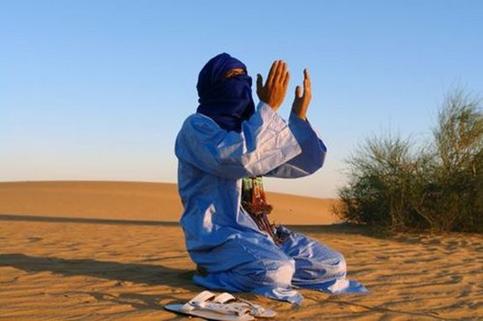
          The veil-cum-turban of the Tuareg tribes of North Africa is a sign of maturity. When a boy becomes a man, the cloth is wound around his face and head until only his eyes are visible. Its significance is both religious and cultural.
          Sufi mystics in Cairo continue a long tradition of veiling when they go into retreat, to isolate themselves from the world. And in the ancient religion of Jainism, both men and women cover their faces when entering their temple's inner sanctum.
          In this audio programme, Navid Akhtar meets the singer Abdullah Ag Alhousseyni from the Tuareg band Tinariwen, talks to men of different faiths about what the veil means to them, and asks whether their stories change the way we perceive women who are veiled.
          http://www.bbc.co.uk/religion/religions/islam/beliefs/hijab_1.shtml


          [/frame]

          هنـــــــــــــا

          îن îëéىهْ نçمùهْ?


          • [frame="13 98"]


            Part 11
            Head coverings (scarves)and face coverings (face veils)[And why do Muslim Men have beards]


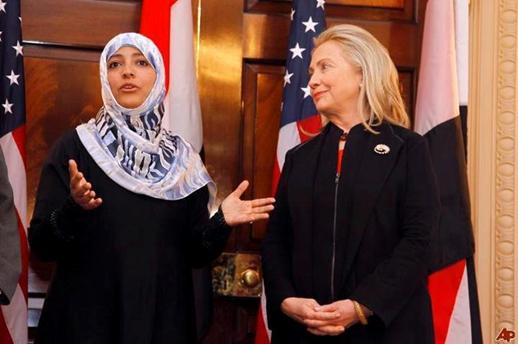
            Nobel Peace Prize winner “Tawakkul Karman,” ‘The mother of Yemen’s revolution,’ when asked about her Hijab by journalists and how it is not proportionate with her level of intellect and education, replied:
            “Man in early times was almost naked, and as his intellect evolved he started wearing clothes. What I am today and what I’m wearing represents the highest level of thought and civilization that man has achieved, and is not regressive. It’s the removal of clothes again that is a regression back to the ancient times.’
            and Interesting article below on “Veil”:
            A veil is an article of clothing, which is intended to cover some part of the head or face. A veil is almost exclusively worn by women, although some instances exist where men also wear a veil. The first recorded instance of veiling for women is recorded in an Assyrian legal ************************ from the 13th century BC which restricted its use to noble women and forbade prostitutes and common women from adopting it. Greek ************************s have also spoken of veiling and seclusion of women being practiced among the Persian elite and statues from Persepolis depict women both veiled and unveiled, and it seems to be regarded as an attribute of higher status.
            Purpose
            For many centuries, until around 1175, Anglo-Saxons and then Anglo-Norman women, with the exception of young unmarried girls, wore veils that entirely covered their hair, and often their necks up to their chins. Only in the Tudor period (1485), when hoods became increasingly popular, did veils of this type become less common. For centuries, women have worn sheer veils, but only under certain circumstances. Sometimes a veil of this type was draped over and pinned to the bonnet or hat of a woman in mourning, especially at the funeral and during the subsequent period of “high mourning”. They would also have been used, as an alternative to a mask, as a simple method of hiding the identity of a woman who was travelling to meet a lover, or doing anything she didn’t want other people to find out about. More pragmatically, veils were also sometimes worn to protect the complexion from sun and wind damage (when un-tanned skin was fashionable), or to keep dust out of a woman’s face.
            Veils with religious significance
            In Judaism and Christianity the concept of covering the head was associated with propriety and can be witnessed in all depictions of Mary the mother of Christ, and was a common practice with Church-going women until the 1960s. A number of very traditional churches do retain the custom even to this day.
            Women’s headcoverings
            Traditionally, in Christianity, women were enjoined to cover their heads in church, just as it was (and still is) customary for men to remove their hat as a sign of respect. This practice is based on the Bible (Corinthians: 11:4-16). In many traditional Eastern Orthodox Churches, and in some very conservative Protestant churches as well, the custom continues of women covering their heads in church (or even when praying privately at home). In the Roman Catholic Church, it was customary, before the 1960s for women in most places to wear a headcovering in the form of a scarf, cap, veil or hat when entering a church. The practice now continues where it is seen as a matter of etiquette, courtesy, tradition or fashionable elegance rather than strictly of religion. Traditionalist Catholics also maintain the practice.
            Muslim veils
            A variety of headdresses worn by Muslim women in accordance with khimar (the principle of dressing modestly) are sometimes referred to as veils or headscarves. Many of these garments cover the hair, ears and throat, but do not cover the face. The niqab and burqa are two kinds of veils that cover most of the face except for a slit or hole for the eyes. The Afghan burqa covers the entire body, obscuring the face completely, except for a grille or netting over the eyes to allow the wearer to see. The boushiya is a veil that may be worn over a headscarf, it covers the entire face and is made of a sheer fabric so the wearer is able to see through it. It has been suggested that the Byzantine practice of wearing a veil – uncommon among the Arab tribes prior to the rise of Islam – originated in the Byzantine Empire, and then spread among the Arabs.
            Other veils
            Veils with hats
            Veils pinned to hats have survived the changing fashions of the centuries and are still common today on occasions when women wear hats. However, these veils are generally made of netting or another material not actually designed to hide the face from view, even if the veil can be pulled down, which is not always the case.
            Wedding veils
            It is not altogether clear that the wedding veil is a non-religious use of this item, since weddings have almost always had religious underpinnings, especially in the West: in the Christian tradition this is expressed in the Gospel passage, “What therefore God has joined together, let no man put asunder” (Mt. 19:6), but veils had been used in the West for weddings long before this (Roman brides, for instance, wore an intensely flame-coloured and fulsome veil, called the flammeum, apparently intended to protect the bride from evil spirits on her wedding day).
            The lifting of the veil was often a part of ancient wedding ritual. In many cultures, the lifting of the wedding veil symbolized the groom taking possession of the wife, either as lover or as property, or the revelation of the bride to the groom by her parents for approval. In ancient Judaism the lifting of the veil took place just prior to the consummation of the marriage in sexual union. The uncovering or unveiling that takes place in the marriage ceremony is a symbol of what will take place in the marriage bed. Just as the two become one through their words spoken in wedding vows, so these words are a sign of the physical oneness that they will consummate later on. The lifting of the veil is a symbol and an anticipation of this. In the story of Jacob in the Old Testament (found in the Book of Genesis), his father-in-law, Laban, tricks Jacob into marrying the wrong woman. Because of the heavily masked veil that was not raised until after the union was complete, Jacob married the older and homelier Leah instead of the young and beautiful Rachel. Rachel was his one true love, and the deceit resulted in Jacob eventually having both as his wives. The story also resulted in the Jewish practice where a groom lowers the veil before the ceremony and lifts the veil before the kiss. This practice is known as Bedeken.
            Courtesans
            Conversely, veils are often part of the stereotypical image of the courtesan and harem woman. Here, rather than the virginity of the bride’s veil, modesty of the Muslim scarf or the piety of the nun’s headdress, the mysterious veil hints at sensuality and the unknown. An example of the veil’s erotic potential is the dance of the seven veils. In this con************************, the term may refer to a piece of sheer cloth approximately 3 yards by 45 inches, sometimes trimmed with sequins or coins, which is used in various styles of belly dancing. A large repertoire of ways to wear and hold the veil exists, many of which are intended to frame the body from the perspective of the audience.
            In West Africa
            Among the Tuareg of West Africa, women do not traditionally wear the veil, while men do. The men’s facial covering originates from the belief that such action wards off evil spirits, but most probably relates to protection against the harsh desert sands as well; in any event, it is a firmly established tradition. Men begin wearing a veil at age 25 which conceals their entire face excluding their eyes. This veil is never removed, even in front of family members.
            http://www.wikigender.org/index.php/Veil

            The head coverings, scarves and veils on the Muslim women
            The virtues of modesty and chastity are the main reasons for Muslim women to wear head coverings, scarves and veil. Another reason is for protection from the disturbing teasing, ogling, and advances which may lead to molestation and lewdness forwarded by those unscrupulous and criminal elements in society. Islam seeks to protect the family life of the society in general, and thus seeks to protect the chastity and moral purity of all members of the society from temptations. This is the main rational for women to wear modest clothing.
            If a man in western societies, for example, sees a Catholic Nun wearing her religious habit (like the famous pictures of Mother Teresa, etc), then he automatically thinks she is protecting her morality and chastity, and therefore sacrosanct and “off limits”. If an unscrupulous man is seeking something illegal in flirtation, fornication and adultery, he turns to see other women who flirt and wear provocative clothing and expose their feminine beauties. Thus the modest clothing of a faithful women acts as a warning flag to stay away from this women for she is chaste and protected.
            As this examples portrays, and by way of this analogy to bring the concept closer to comprehension, the rationale for modest clothing and covering in Muslim societies is the same. And yet Muslim women have the obligation to follow and observe specifically strict instruction in this regard as mentioned below.
            Observant female followers of Judaism always wear head coverings as obligatory, and many Christian women wear scarves and head coverings to church, and even face veils were common. At some Jewish and Christians weddings a face veil is traditional since this is the heritage of the symbol of faith in Gods teachings about morality, modesty and chastity before marriage, and the sign the sanctity chastity and faithfulness in marriage, of family life, and of motherhood .
            I always naturally thought about this – I realize now upon reflection – when as a child I looked at those bible pictures of the Holy Land, seeing the modestly dressed men always with beards, and women always with head coverings. That was a long time before I accepting Islam, and the praise is for Allah, the One God and Lord Sovereign of the Universe who guides whom He will.
            As my wife and I were strolling one day in the grocery store in the same Midwestern town, a little girl said to her mother – commenting on my wife and her appearance: mommy …mommy look! Mary!
            What this innocent little girl saw was exactly what I saw as a child: the images of middle eastern women in modest clothing, as a sign of their modesty, chastity, and faith in God.
            A Midwestern Christian preacher and missionary said to me that his grandmother would never go to church without her face veil, as was customary in those days. How much change in the USA have we seen in one generation after the so called sexual revolution of the 60s.
            In Christianity the covering of the head in church is obligatory according to the passage of the New Testament of the Bible of Corinthians 11:4-16 which includes:
            “ 5And every woman who prays or prophesies with her head uncovered dishonors her head—it is just as though her head were shaved. 6If a woman does not cover her head, she should have her hair cut off; and if it is a disgrace for a woman to have her hair cut or shaved off, she should cover her head.“
            Reflection on Muslim women’s dress with loose clothing, head covering and face veil:
            Some have tried to portray the modest clothing and head scarf of observant Muslim woman and especially the face veil of some Muslim women, as a sign of oppressive male dominance and the abject subjugation of women in Muslim societies. They seek to liberate Muslim women from this repression, and call them to take off their coverings, throw away their veils, and wear revealing modern clothes which expose their feminine beauties in fashionable manners, or so they claim.
            They portray this as an evil that must be countered with rigorous propaganda and even rules and laws which outlaw such expressions of so called “humiliation” and “subjugation”.

            [/frame]

            هنـــــــــــــا

            îن îëéىهْ نçمùهْ?


            • [frame="13 98"]

              <STYLE><!--.ExternalClass .ecxhmmessage P{padding:0px;}.ExternalClass body.ecxhmmessage{font-size:10pt;font-family:Tahoma;}--></STYLE>
              Some Muslim men and women have been affected by the propaganda and heeded this call.
              The reality is that the modest dress of a observant Muslim woman, covering her feminine beauty, is liberation from the sex slavery that many modern women have fallen into. We say slavery because they have fallen into the degradation of their dignity and humanity by exposing their nakedness publicly, by subjugating themselves to the crass exploitation and commercialization of their precious bodies, by making themselves an object of unlawful desire by their manners and their dress, by and submitting themselves to the propaganda calling to extramarital sexual relationships.
              All of this slavery is an attack upon morality and the preservation of the purity of family life. Extramarital sexual relationships are seen by Islam, Judaism and Christianity, in unanimity, as immoral, unlawful, and sinful, deserving of punishment in this life and the Hereafter.
              The commands of Islamic ************************s concerning women’s modest dress and coverings are unequivocal in the in the Quran and the Sunnah.
              Note that there is some difference of scholarly Muslim jurist opinion in interpreting the commands in the sources of Islamic law – the Quran and the Sunnah – concerning the obligation of the face veil, and yet the controversy is only about is the face veil whether it is obligatory or not. All competent Muslim scholars and jurist say that the head and body covering of a mature Muslim woman is obligatory. All say that the face veil of a mature Muslim woman is recommended as voluntary and supererogatory, and some say it becomes obligatory if temptation is feared. Thus the controversy is mainly only concerning this question of Islamic law: is the face veil obligatory or only supererogatory?
              Just a few Evidences from the Qur&aacute;n:
              And Allah the most Exalted said:
              قوله تعالى: (يأَيُّهَا النَّبِىُّ قُل لاَِزْوَاجِكَ وَبَنَـاتِكَ وَنِسَآءِ الْمُؤْمِنِينَ يُدْنِينَ عَلَيْهِنَّ مِن جَلَابِيبِهِنَّ ذلِكَ أَدْنَى أَن يُعْرَفْنَ فَلاَ يُؤْذَيْنَ وَكَانَ اللَّهُ غَفُوراً رَّحِيماً ). الأحزاب:59.
              The saying of Allah, Most Exalted: “O Prophet, tell your wives and your daughters and the believing women to spread over themselves from their outer garments. That is more suitable that they will be known and will not be abused (or molested). And Allah is most Forgiving and most Merciful [al-Ahzab 59]
              Abdullah Ibn Abbas, may Allah be pleased with them, said: “Allah commanded the believing women that when they go out of their homes for some need of theirs, they cover their faces starting from their heads with their “Jalabeeb” (outer garments) and they are allowed to have one eye appear (to see).”
              When this verse was revealed, Um Salamah, may Allah be pleased with her (the wife of the Prophet peace be upon him), said: “ The women of the Ansar came out (of their homes) as if they had (black) crows on their heads from their serenity, and they wore black clothes.” Ibadah as-Salmani and others (who witness and testify) said that the believing women would let their outer garments cover down from the top of their heads such that nothing will show except their eyes for the sake of seeing the way.”
              And Allah the most Exalted said:
              )وَقُل لِّلْمُؤْمِنَـاتِ يَغْضُضْنَ مِنْ أَبْصَـارِهِنَّ وَيَحْفَظْنَ فُرُوجَهُنَّ وَلاَ يُبْدِينَ زِينَتَهُنَّ إِلاَّ مَا ظَهَرَ مِنْهَا وَلْيَضْرِبْنَ بِخُمُرِهِنَّ عَلَى جُيُوبِهِنَّ وَلاَ يُبْدِينَ زِينَتَهُنَّ إِلاَّ لِبُعُولَتِهِنَّ أَوْ ءَابَآئِهِنَّ أَوْ ءَابَآءِ بُعُولَتِهِنَّ أَوْ أَبْنَآئِهِنَّ أَوْ أَبْنَآءِ بُعُولَتِهِنَّ أَوْ إِخْوَانِهِنَّ أَوْ بَنِي إِخْوَانِهِنَّ أَوْ بَنِي أَخَوَتِهِنَّ أَوْ نِسَآئِهِنَّ أَوْ مَا مَلَكَتْ أَيْمَـانُهُنَّ أَوِ التَّـابِعِينَ غَيْرِ أُوْلِى الإِرْبَةِ مِنَ الرِّجَالِ أَوِ الطِّفْلِ الَّذِينَ لَمْ يَظْهَرُواْ عَلَى عَوْرَاتِ النِّسَآءِ وَلاَ يَضْرِبْنَ بِأَرْجُلِهِنَّ لِيُعْلَمَ مَا يُخْفِينَ مِن زِينَتِهِنَّ وَتُوبُواْ إِلَى اللَّهِ جَمِيعاً أَيُّهَ الْمُؤْمِنُونَ لَعَلَّكُمْ تُفْلِحُونَ (.النور 31:
              “And tell the believing women to lower their gaze and guard their private parts and not to display their adornment (and beauty), except that which appears thereof (ordinarily) and to draw their coverings over their chests and not to display their adornments except to their husbands, their fathers, their husband’s fathers, their sons, their husband’s sons, their brothers, their brothers’ sons, their sisters’ sons, their women, and those whom their right hands possess (their slaves) or those male attendants having no physical desire, or children who are not yet aware of the private aspects of women. And let them not stamp their feet to make known what they conceal of their adornments. And turn to Allah in repentance, all of you, O believers, that you might succeed.” [Nur 31]
              And so on and so forth in the various evidences from the Quran and the Sunnah concerning the obligation of Muslim women to cover their feminine beauties for their own protection, and as a sign of their faith in God Almighty and His wise commands for their salvation in this world and the Hereafter
              Part III
              1 – Evidence from the Qur’aan
              ========================
              (i) Allaah says (interpretation of the meaning):
              “And tell the believing women to lower their gaze (from looking at forbidden things), and protect their private parts (from illegal sexual acts) and not to show off their adornment except only that which is apparent (like both eyes for necessity to see the way, or outer palms of hands or one eye or dress like veil, gloves, headcover, apron), and to draw their veils all over Juyoobihinna (i.e. their bodies, faces, necks and bosoms) and not to reveal their adornment except to their husbands, or their fathers, or their husband’s fathers, or their sons, or their husband’s sons, or their brothers or their brother’s sons, or their sister’s sons, or their (Muslim) women (i.e. their sisters in Islam), or the (female) slaves whom their right hands possess, or old male servants who lack vigour, or small children who have no sense of feminine sex. And let them not stamp their feet so as to reveal what they hide of their adornment. And all of you beg Allaah to forgive you all, O believers, that you may be successful”
              [al-Noor 24:31]

              The evidence from this verse that hijab is obligatory for women is as follows:
              (a) Allaah commands the believing women to guard their chastity, and the command to guard their chastity also a command to follow all the means of doing that. No rational person would doubt that one of the means of doing so is covering the face, because uncovering it causes people to look at it and enjoy its beauty, and thence to initiate contact.
              The Messenger of Allaah (peace and blessings of Allaah be upon him) said: “The eyes commit zina and their zina is by looking…” then he said, “… and the private part confirms that or denies it.” Narrated by al-Bukhaari, 6612; Muslim, 2657.
              If covering the face is one of the means of guarding one’s chastity, then it is enjoined, because the means come under the same ruling as the ends.
              (b) Allaah says (interpretation of the meaning):
              “…and to draw their veils all over Juyoobihinna (i.e. their bodies, faces, necks and bosoms) …”. The jayb (pl. juyoob) is the neck opening of a garment and the khimaar (veil) is that with which a woman covers her head. If a woman is commanded to draw her veil over the neck opening of her garment then she is commanded to cover her face, either because that is implied or by analogy. If it is obligatory to cover the throat and chest, then it is more appropriate to cover the face because it is the site of beauty and attraction.
              (c) Allaah has forbidden showing all adornment except that which is apparent, which is that which one cannot help showing, such as the outside of one’s garment. Hence Allaah says (interpretation of the meaning): “…except only that which is apparent …” and He did not say, except that which they show of it. Some of the salaf, such as Ibn Mas’ood, al-Hasan, Ibn Sireen and others interpreted the phrase “except only that which is apparent” as meaning the outer garment and clothes, and what shows from beneath the outer garment (i.e., the hem of one’s dress etc.). Then He again forbids showing one’s adornment except to those for whom He makes an exception. This indicates that the second adornment mentioned is something other than the first adornment. The first adornment is the external adornment which appears to everyone and cannot be hidden. The second adornment is the inward adornment (including the face). If it were permissible for this adornment to be seen by everyone, there would be no point to the general wording in the first instance and this exception made in the second.
              (d) Allaah grants a concession allowing a woman to show her inward adornments to “old male servants who lack vigour”, i.e. servants who are men who have no desire, and to small children who have not reached the age of desire and have not seen the ‘awrahs of women.
              This indicates two things:
              1 – That showing inward adornments to non-mahrams is not permissible except to these two types of people.
              2 – That the reason for this ruling is the fear that men may be tempted by the woman and fall in love with her. Undoubtedly the face is the site of beauty and attraction, so concealing it is obligatory lest men who do feel desire be attracted and tempted by her.
              (e) The words (interpretation of the meaning): “And let them not stamp their feet so as to reveal what they hide of their adornment” mean that a woman should not stamp her feet so as to make known hidden adornments such as anklets and the like. If a woman is forbidden to stamp her feet lest men be tempted by what they hear of the sound of her anklets etc., then what about uncovering the face?
              Which is the greater source of temptation – a man hearing the anklets of a woman whom he does not know who she is or whether she is beautiful, or whether she is young or old, or ugly or pretty? Or his looking at a beautiful youthful face that attracts him and invites him to look at it?
              Every man who has any desire for women will know which of the two temptations is greater and which deserves to be hidden and concealed.
              (ii) Allaah says (interpretation of the meaning):
              “And as for women past childbearing who do not expect wedlock, it is no sin on them if they discard their (outer) clothing in such a way as not to show their adornment. But to refrain (i.e. not to discard their outer clothing) is better for them. And Allaah is All‑Hearer, All‑Knower”
              [al-Noor 24:60]
              The evidence from this verse is that Allaah states that there is no sin on old women who have no hope of marriage because men have no desire for them, due to their old age (if they discard their outer clothing), subject to the condition that their intention in doing so is not to make a wanton display of themselves. The fact that this ruling applies only to old women indicates that the ruling is different for young women who still hope to get married. If the ruling on discarding the outer clothing applied to all, there would be no point in singling out old women here.
              The phrase “in such a way as not to show their adornment” offers further proof that hijab is obligatory for young women who hope to marry, because usually when they uncover their faces the intention is to make a wanton display (tabarruj) and to show off their beauty and make men look at them and admire them etc. Those who do otherwise are rare, and the ruling does not apply to rare cases.
              (iii) Allaah says (interpretation of the meaning):
              “O Prophet! Tell your wives and your daughters and the women of the believers to draw their cloaks (veils) all over their bodies (i.e. screen themselves completely except the eyes or one eye to see the way). That will be better, that they should be known (as free respectable women) so as not to be annoyed. And Allaah is Ever Oft‑Forgiving, Most Merciful”
              [al-Ahzaab 33:59]
              Ibn ‘Abbaas (may Allaah be pleased with him) said: “Allaah commanded the believing women, if they go out of their houses for some need, to cover their faces from the top of their heads with their jilbaabs, and to leave one eye showing.”
              The tafseer of the Sahaabah is evidence, indeed some of the scholars said that it comes under the same ruling as marfoo’ reports that go back to the Prophet (peace and blessings of Allaah be upon him).
              The comment “and leave one eye showing” is a concession because of the need to see the way; if there is no need for that then the eye should not be uncovered.
              The jilbaab is the upper garment that comes above the khimaar; it is like the abaya.
              (iv) Allaah says (interpretation of the meaning):
              “It is no sin on them (the Prophet’s wives, if they appear unveiled) before their fathers, or their sons, or their brothers, or their brother’s sons, or the sons of their sisters, or their own (believing) women, or their (female) slaves. And (O ladies), fear (keep your duty to) Allaah. Verily, Allaah is Ever All‑Witness over everything”
              [al-Ahzaab 33:55]
              Ibn Katheer (may Allaah have mercy on him) said: When Allaah commanded the women to observe hijab in front of non-mahram men, he explained that they did not have to observe hijab in front of these relatives, as He explained that they are exempted in Soorat al-Noor where He said (interpretation of the meaning): “and not to reveal their adornment except to their husbands…”

              2 – Evidence from the Sunnah that it is obligatory to cover the face
              ========================
              (i) The Prophet (peace and blessings of Allaah be upon him) said: “When any one of you proposes marriage to a woman, there is no sin on him if he looks at her, rather he should look at her for the purpose of proposing marriage even if she is unaware.” Narrated by Ahmad. The author of Majma’ al-Zawaa’id said: its men are the men of saheeh.
              The evidence here is the fact that the Prophet (peace and blessings of Allaah be upon him) said there is no sin on the man who is proposing marriage, subject to the condition that his looking be for the purpose of proposing marriage. This indicates that the one who is not proposing marriage is sinning if he looks at a non-mahram woman in ordinary circumstances, as is the one who is proposing marriage if he looks for any purpose other than proposing marriage, such as for the purpose of enjoyment etc.
              If it is said that the hadeeth does not clearly state what is being looked at, and it may mean looking at the chest etc, the response is that the man who is proposing marriage looks at the face because it is the focus for the one who is seeking beauty, without a doubt.
              (ii) When the Prophet (peace and blessings of Allaah be upon him) commanded that women should be brought out to the Eid prayer place, they said, “O Messenger of Allaah, some of us do not have jilbaabs.” The Prophet (peace and blessings of Allaah be upon him) said, “Let her sister give her one of her jilbaabs to wear.” Narrated by al-Bukhaari and Muslim.
              This hadeeth indicates that the usual practice among the women of the Sahaabah was that a woman would not go out without a jilbaab, and that if she did not have a jilbaab she would not go out. The command to wear a jilbaab indicates that it is essential to cover. And Allaah knows best.
              (iii) It was narrated in al-Saheehayn that ‘Aa’ishah (may Allaah be pleased with her) said: The Messenger of Allaah (peace and blessings of Allaah be upon him) used to pray Fajr and the believing women would attend the prayer with him, wrapped in their veils, then they would go back to their homes and no one would recognize them because of the darkness. She said: If the Messenger of Allaah (peace and blessings of Allaah be upon him) saw from the women what we have seen, he would have prevented them from coming to the mosques as the Children of Israel prevented their women.
              A similar report was also narrated by ‘Abd-Allaah ibn Mas’ood (may Allaah be pleased with him).
              The evidence from this hadeeth covers two issues:
              1 – Hijaab and covering were the practice of the women of the Sahaabah who were the best of generations and the most honourable before Allaah.
              2 – ‘Aa’ishah the Mother of the Believers and ‘Abd-Allaah ibn Mas’ood (may Allaah be pleased with them both), who were both known as scholars with deep insight, said that if the Messenger (peace and blessings of Allaah be upon him) had seen from women what they had seen, he would have prevented them from coming to the mosques. This was during the best generations, so what about nowadays?!
              (iv) It was narrated that Ibn ‘Umar said: The Messenger of Allaah (peace and blessings of Allaah be upon him) said: “Whoever lets his garment drag out of pride, Allaah will not look at him on the Day of Resurrection.” Umm Salamah said, “What should women do with their hems?” He said, “Let it hang down a handspan.” She said, “What if that shows her feet?” He said, “Let it hang down a cubit, but no more than that.” Narrated by al-Tirmidhi; classed as saheeh by al-Albaani in Saheeh al-Tirmidhi.
              This hadeeth indicates that it is obligatory for women to cover their feet, and that this was something that was well known among the women of the Sahaabah (may Allaah be pleased with them). The feet are undoubtedly a lesser source of temptation than the face and hands, so a warning concerning something that is less serious is a warning about something that is more serious and to which the ruling applies more. The wisdom of sharee’ah means that it would not enjoin covering something that is a lesser source of temptation and allow uncovering something that is a greater source of temptation. This is an impossible contradiction that cannot be attributed to the wisdom and laws of Allaah.
              (v) It was narrated that ‘Aa’ishah said: The riders used to pass by us when we were with the Messenger of Allaah (peace and blessings of Allaah be upon him) in ihraam. When they came near us we would lower our jilbaabs from our heads over our faces, and when they had passed by we would uncover our faces. Narrated by Abu Dawood, 1562.


              [/frame]

              هنـــــــــــــا

              îن îëéىهْ نçمùهْ?


              • [frame="13 98"]

                <STYLE><!--.ExternalClass .ecxhmmessage P{padding:0px;}.ExternalClass body.ecxhmmessage{font-size:10pt;font-family:Tahoma;}--></STYLE>
                The words “When they came near us we would lower our jilbaabs from our heads over our faces” indicate that it is obligatory to cover the face, because what is prescribed in ihraam is to uncover it. If there was no strong reason to prevent uncovering it, it would be obligatory to leave it uncovered even when the riders were passing by. In other words, women are obliged to uncover their faces during ihraam according to the majority of scholars, and nothing can override something that is obligatory except something else that is also obligatory. If it were not obligatory to observe hijab and cover the face in the presence of non-mahram men, there would be no reason not to uncover it in ihraam. It was proven in al-Saheehayn and elsewhere that a woman in ihraam is forbidden to wear the niqaab (face veil) and gloves.
                Shaykh al-Islam Ibn Taymiyah said: This is one of the things which indicate that the niqaab and gloves were known among women who were not in ihraam, which implies that they covered their faces and hands.
                ================================================
                These are nine points of evidence from the Qur’aan and Sunnah.
                ================================================

                The tenth is:
                Rational examination and analogy which form the basis of this perfect sharee’ah, which aims to help people achieve what is in their best interests and encourages the means that lead to that, and to denounce evil and block the means that lead to it.
                If we think about unveiling and women showing their faces to non-mahram men, we will see that it involves many bad consequences. Even if we assume that there are some benefits in it, they are very few in comparison with its negative consequences. Those negative consequences include:
                1 – Fitnah (temptation). By unveiling her face, a woman may be tempted to do things to make her face look more beautiful. This is one of the greatest causes of evil and corruption.
                2 – Taking away haya’ (modesty, shyness) from women, which is part of faith and of a woman’s nature (fitrah). Women are examples of modesty, as it was said, “more shy than a virgin in her seclusion.” Taking away a woman’s modesty detracts from her faith and the natural inclination with which she was created.
                3 – Men may be tempted by her, especially if she is beautiful and she flirts, laughs and jokes, as happens in the case of many of those who are unveiled. The Shaytaan flows through the son of Adam like blood.
                4 – Mixing of men and women. If a woman thinks that she is equal with men in uncovering her face and going around unveiled, she will not be modest and will not feel too shy to mix with men. This leads to a great deal of fitnah (temptation) and widespread corruption. Al-Tirmidhi narrated (5272) from Hamzah ibn Abi Usayd from his father that he heard the Messenger of Allaah (peace and blessings of Allaah be upon him) say, when he was coming out of the mosque and he saw men mingling with women in the street; the Messenger of Allaah (peace and blessings of Allaah be upon him) said to the women, “Draw back, and do not walk in the middle of the road; keep to the sides of the road.” Then the women used to keep so close to the walls that their garments would catch on the walls because they kept so close to them.
                Classed as hasan by al-Albaani in Saheeh al-Jaami’, 929
                Adapted from the words of Shaykh Muhammad ibn ‘Uthaymeen (may Allaah have mercy on him) in Risaalat al-Hijaab.
                And Allaah knows best.
                [COLOR=window************************]http://www.turntoislam.com/forum/showthread.php?t=3322[/COLOR]

                View that the Niqab is Obligatory Niqaab According to Quran and SunnahRevelation of Al-Hijab Hadith – Bukhari 1:148


                The wives of the Prophet used to go to Al-Manasi, a vast open place (near Baqia at Medina) to answer the call of nature at night.
                ‘Umar radhian Allaahu anhu used to say to the Prophet “Let your wives be veiled,” but Allaah’s Apostle did not do so.
                One night Sauda bint Zam’a radhian Allahu anha the wife of the Prophet went out at ‘Isha’ time and she was a tall lady. ‘Umar radhian Allahu anhu addressed her and said, “I have recognized you, O Sauda.” He said so, as he desired eagerly that the verses of Al-Hijab (the observing of veils by the Muslim women) may be revealed. So Allaah revealed the verses of “Al-Hijab”
                The Noble Qur’an – Al-Ahzab 33:59
                “O Prophet! Tell your wives and your daughters and the women of the believers to draw their cloaks (veils)** all over their bodies (i.e. screen themselves completely except the eyes or one eye to see the way). That will be better, that they should be known (as free respectable women) so as not to be annoyed. And Allaah is Ever Oft-Forgiving, Most Merciful. “
                **the arabic word here is Jalabeeb (plural of Jalbaab), which is the loose outer garment that covers all a woman’s body. It says here to use the Jalabeeb to cover all, and scholars say this means to use it to cover her head (agree upon by all scholars) and her face (agreed by many scholars, not all) and one or both eyes, in order for it to be known that she is a free woman and so not to be exposed to any harm.
                Hadith – Bukhari 6:282
                ‘Aisha radhian Allaha anha used to say: “When (the Verse): ‘They should draw their veils over their necks and bosoms,’ was revealed, (the ladies) cut their waist sheets at the edges and covered their faces with the cut pieces.”
                Hadith – Abu Dawud, Narrated Umm Salamah, Ummul Mu’minin
                When the verse “That they should cast their outer garments over their persons” was revealed, the women of Ansar came out as if they had crows over their heads by wearing outer garments.
                The lower half of the hijab is a garment that does not show the woman’s figure. Jeans and certain obvious garments do not meet this requirement.
                Hadith – Abu Dawud, Narrated Dihyah ibn Khalifah al-Kalbi
                The Apostle of Allah was brought some pieces of fine Egyptian linen and he gave me one and said:
                “Divide it into two; cut one of the pieces into a shirt and give the other to your wife for veil. Then when he turned away, he said: And order your wife to wear a garment below it and not show her figure. “
                Prescribed Methods of Covering
                Tafseer – Ibn Katheer
                “Allaah commanded the muslim women to cover this sheet on top of them to cover their bodies except one eye, when it is necessary for them to come out of their homes.”

                Tafseer – Commentary by Ibn Jarir and Ahkam-ul-Quran, Vol.III, p.457
                Imam Muhammad bin Sirin said: “When I asked Ubaida bin Sufyan bin al-Harith radhian Allahu anhu the meaning of this verse and how the jalbaab was to worn, he demonstrated it to me by pulling a sheet of cloth over his head to cover his entire body, leaving the left eye uncovered. This was also the explanation of the word ‘Alaihinna in this verse”
                Tafseer – Alu’si, Rul-ul-Ma’ani, Vol. 22, p. 89
                “Ibn Jarir Tabari and Ibn Al-Mundhir described the method of wearing the jalbaab according to Ibn Abbas and Qatadah radhian Allahu anhuma. The sheet should be wrapped around from the top, covering the forehead, then bringing one side of the sheet to cover the face below the eyes so that most of the face and the upper body is covered. This will leave both eyes uncovered (which is allowed in necessity). “
                Colour of Garment
                The female companions were known to wear black and dark colors (such as the hadith above, “crows on their heads”), but other colors are also permissible for a woman to wear. She must not wear any color, however, in vanity.

                Hadith – Sahih Al-Bukhari 7.715
                …’Aisha radhian Allaahu anha said that the lady (came), wearing a green veil …
                Hadith – Sahih Al-Bukhari 7.733
                ..that he had seen Um Kulthum radhian Allaahu anha, the daughter of Allaah’s Apostle , wearing a red silk garment.
                Hadith – Sahih Al-Bukhari 7.713
                The Prophet was given some clothes including a black Khamisa. The Prophet said,
                “To whom shall we give this to wear?” The people kept silent whereupon the Prophet said, “Fetch Um Khalid for me.” I (Um Khalid) was brought carried (as I was small girl at that time).
                The Prophet took the Khamisa in his hands and made me wear it and said, “May you live so long that your dress will wear out and you will mend it many times.”
                On the Khamisa there were some green or pale designs (The Prophet these designs) and said, “O Um Khalid! This is Sanah.” (Sanah in a Ethiopian word meaning beautiful).
                Hadith – Sunan of Abu Dawood #4055,
                Narrated Abdullah ibn Amr ibn al-’As radhian Allaahu anhu,
                “We came down with the Apostle of Allaah from a turning of a valley. He turned his attention to me and I was wearing a garment dyed with a reddish yellow dye. He asked: “What is this garment over you?”
                I recognised what he disliked. I then came to my family who were burning their oven. I threw it (the garment) in it and came to him the next day. He asked: “Abdullah, what have you done with the garment?”

                I informed him about it. He said: Why did you not give it to one of your family to wear, for there is no harm in it for women.”

                Must a Woman Wear Niqaab (Veil)?
                The general understanding in Islam regarding Sunnah, is that if the Prophet or any of his wivesradhian Allaahu anhuna or companions radhian Allaahu anhum are recorded in authentic hadith to have engaged in an act that is not haram (prohibited) as defined by Qur’aan or Sunnah, then the act is declared halal (permissible). If the companions engaged in an act that the Prophet was aware of and did not speak out against, it is halal.
                It is well-known that the wives of the Prophet covered their faces any time non-mahram men were near. A woman named Asma, who was not a wife of the Prophet , was also recorded as covering her face. Easily, one can conclude that wearing veil is halal (permissible).
                However, Muslims and Muslimahs across the world have been in “hot debate” for centuries, over the issue of whether or not covering the face is obligatory upon a Muslimah. Those who argue that it is not required, point to the use of the word khimar in the Qur’aan, and explain that today’s modern khimar does not cover the face, and argue that khimar has never referred to the covering of the face, but only to that of the hair, neck, and bosoms. While one cannot deny the support of Hadith that indicate that the Prophet’s wives wore khimar, one must realize that they also covered their faces at all times in the presence of non-mahram men.
                The group of scholars agree that it is a highly recommended act to cover the face. The scholars also agree that a woman must cover her adornment, yet some scholars argue that this does not include the face.
                BASING ON CULTURE VS. QUR’AAN AND SUNNAH. …Most Muslim men, even in America, would be pleased if their wives veil, but some state that a veil draws too much attention, causing men to look upon her more than normal. However, one must realize that when men ‘look’, they have nothing of her to see! Regardless, this issue must stick to understanding and implementing Qur’aan and Sunnah, and not making excuses based on the current culture. Muslims are ordered not to imitate the dress of any non-Muslim culture, so, surely, we cannot make the choice to wear Niqab based on the pressures of modern day society; instead, we choose, insha^Allaah, to fear Allaahu Ta’ala, and not mankind!
                When in a state of ihram, the muslimah cannot wear niqaab. However, according to several scholars, such as Sheikh ibn Baz, even when in a state of ihram, “she should lower her headcovering or outer cloak over her face when she is in the presence of non-mahram men.” So, it is to say that she should not cover her face around the other women during ihram, but that she should cover it if a non-mahram man approaches. He bases this on the hadith below, narrated by ‘Aisha radhian Allaahu anha.
                In Fathul Bari, chapter Hajj, a tradition reported on the authority of Aisha (RA) says:
                “A woman in a state of Ihram (during Hajj and Umrah) should stretch her head – cloth over to her face to hide it.”
                Hadith – Recorded by Ahmad, Abu Dawud and ibn Majah,
                Narrated ‘Aisha radhian Allaahu anha. [In his work Jilbab al-Marah al-Muslimah, al-Albani states (p. 108) that it is hasan due to corroborating evidence. Also, in a narration from Asma radhian Allaahu anha, Asma also covered her face at all times in front of men.]
                Narrated ‘Aisha radhian Allaahu anha who said, “The riders would pass us while we were with the Messenger of Allah ). When they got close to us, we would draw our outer cloak from our heads over our faces. When they passed by, we would uncover our faces.”
                According to Shaikh ibn Uthaiymin, “she is not required to cover her face during the prayer unless there are non-related men around her. She must then cover her face from them, as it is not allowed for a woman to uncover her face except to her husband and her male relatives i.e., mahram.”
                If a woman is not around any non-mahram men and does not fear that any will enter her area of salah, she may reveal her face and hands. This is agreed upon by the group of scholars.
                So, whether agreeing that niqab is required or not, one must surely acknowledge that it is a desirous sign of piety. What better example of sunnah to follow for a muslimah than that of the Prophet and his wives RA. Every Muslimah is encouraged to cover to the fullest, showing only one or both eyes.
                A woman does not have to wear a niqab (affixed veil), but she should emulate the female companions by using her hijab or other items, to lift and cover her face when a non-mahram man approaches, even during ihram (hajj), as this is in accordance with sunnah.
                Hadith – Muwatta 20.16
                Yahya related to me from Malik from Hisham ibn Urwa that Fatima bint al-Mundhir said,
                “We used to veil our faces when we were in ihram in the company of Asma bint Abi Bakr as-Siddiq radhian Allaahu anha.”
                The following Fatawa is from Sheikh Ibn Uthaiymin:
                “The Islamic hijab is for the women to cover everything that is forbidden for her to expose. That is, she covers everything that she must cover.
                “The first of those bodily parts that she must cover is her face. It is the source of temptation and the source of people desiring her. Therefore, the woman must cover her face in front of those men that are not Mahram (i.e. father, husband, etc.).
                “As for those who claim that Islamic hijab is to cover the head, shoulders, back, feet, shin and forearms while allowing her to uncover her face and hands, this is a very amazing claim. This is because it is well-known that the source of temptation and looking is the face. How can one say that the Shariah does no allow the exposure of the foot of the woman while it allows her to uncover her face?
                “It is not possible that there could be in the Esteemed, Wise and Noble Shariah a contradiction. Yet everyone knows that the temptation from uncovering the face is much greater than the temptation that results from the uncovering of the feet. Everyone also knows that the most sought after aspect of the woman for men is the face. If you told a prospective groom that a woman’s face is ugly but her feet are beautiful, he would not propose to such a woman.
                “However, if you told him that her face was beautiful but her hands, palms, or shins were less than beautiful, he would still propose to her. From this one can conclude that the face is the first thing that must be covered.
                “There are also evidences from the Book of Allaah Ta’ala and the Sunnah of our Prophet . There are also statements from the Companions radhian Allaahu anhum , the leading Imams and the great scholars of Islam that indicate that it is obligatory for the woman to cover all of her body in the presence of non-Mahram men. This obviously indicates that it is obligatory upon the woman to cover her face in front of such men.”
                Refutation For those who claim niqaab is not wajib and the face and hands of a woman can be seen by (ghairMahrrum) strange men.

                [/frame]

                هنـــــــــــــا

                îن îëéىهْ نçمùهْ?


                • [frame="13 98"]

                  <STYLE><!--.ExternalClass .ecxhmmessage P{padding:0px;}.ExternalClass body.ecxhmmessage{font-size:10pt;font-family:Tahoma;}--></STYLE>

                  Refutation from Shaikh Ibn Uthaymeen
                  This is taken from the book “Hijaab” by Shaikh Ibn Uthaymeen from Saudi Arabia. Printed by Madrasah Arabia Islamia Azaadville- South Africa.
                  Translated by Hafedh Zaheer Essack, Rajab 1416 (December 1995)
                  The Ulamah who are of the opinion that it is permissible to look at the face and hands of a strange woman (who is not mahrrum) say so mainly for the following reasons.
                  The hadeeth of Ayeshah radhian Allaahu anha when Asmaa radhian Allaahu anha the daughter of Abu Bakr radhian Allaahu anhu came to the Rasulullaah while wearing thin clothing.
                  He approached her and said: ‘O Asmaa! When a girl reaches the menstrual age, it is not proper that anything should remain exposed except this and this. He pointed to the face and hands. But this hadeeth is WEAK because of 2 main weaknesses.
                  There is no link between Ayeshah (Radhiallaahu &Aacute;nha) and Khalid bin Dareek, who narrated the hadith from her. And in every chain of narrators Khalid bin Dareek is mentioned.
                  In the chain of narrators Sa’eed bin Basheer appears, who is known by most of the Muhaditheen as being a weak narrator.
                  This has been mentioned by Imaam Ahmad bin Hanbal (Rahimahullah), An-Nasai (Rahimahullah), Ibn Madeeni (Rahimahullah) and Ibn Ma’een (Rahimahullah). This is also why Imaam Bukhari (Rahimahullah) and Muslim (Rahimahullah) did not except this hadeeth to be in their books. (From Shaikh Ibn Uthaymeen in the book “Hijaab” pages # 17 and 18.)
                  We also have to see that the Muhadith Abu Dawood when he quoted this hadeeth put with it that it is Mursal (with a broken chain that does not lead up to the Sahabah).
                  (From The Book “Hijaab wa Safur” under the fatwaa of Shaikh Abdul Aziz Bin Bazz on Page #61. Also stated as being weak by Shaikh Nasiruddeen Al-Albaani in his Daeef Sunan Abu Dawud in Kitab-ul-Libas under hadeeth number 4092 (which is the original hadeeth number.)
                  An other thing that shows the weakness of this hadith is that after the ayah for hijab (Surah Al-Ahzaab – Verse #59) was revealed then the women of Sahaba wore a complete veil and covered the faces and hands. This includes Asmaa (Radhiallaahu &Aacute;nha) the daughter of Abu Bakr, who is supposed to have narrated this hadeeth. Asmaa (Radhiallaahu &Aacute;nha) covered herself completely including the face, this has been narrated in authentic hadeeth in Imaam Malik’s “MUWATTA Book 20 Hadeeth # 20.5.16.”
                  What Age Must a Female Wear Niqaab?
                  It is unquestionable that a female must begin covering by the age of puberty. In all situations, Muslims are to use the Prophet’s example for guidance. The Prophet married ‘Aisha radhian Allaahu anha before she had reached puberty and consummated the marriage when she was approximately 9 years old. Getting married at such an age was not uncommon until recent times.
                  Puberty begins two weeks before the onset of the first menstrual period, i.e. this is the time in which she is capable of becoming pregnant.
                  May Allaah Ta’ala guide each parent to adequately prepare the daughter for hijaab and their other responsibilities, in time for puberty. Amiyn.
                  If a mother or father recently converts to Islam and has a daughter who has reached puberty, s/he should immediately begin covering the daughter. The parents should educate the daughter to understand and appreciate the reasons and advantages for covering as a Muslimah is instructed to.
                  The new revert to Islam should not feel apologetic for covering a daughter who was not previously covering. It is as much of an advantage to her as to the new adult muslimah revert, and children do not always know what is best for them, so, like other decisions you make daily for your children, do not leave the issue of wearing hijab up to your children. Make the transition as a family, not you first, then just hoping the children follow suit on their own.
                  Some guidelines for preparing a child for hijab. [/center]
                  It is encouraged that as soon as the child is able to walk, she does not wear clothes that resemble the kafr, and that she should always have her knees and as much as possible of the arms and legs covered when leaving the house or having guests over.
                  She should be taught modesty in behavior and dress from the cradle.
                  It is ideal to sew small jilbabs (light overcoats) and khimaar (head/neck/chest covering) for the young muslimah, properly preparing her for full coverage at puberty. It is actually less fitnah on the parent to dress her in the simple attire of a muslim, as compared to looking for fashionable clothes in a shopping mall.
                  At the age of 7, the parent should order her to pray salaah, and of course, she must be wearing hijaab (the entire head and body covering) for the salaah.
                  By the age of 10, her parents may and should punish her for missing fard (obligatory) salaah, and once again, she must be wearing hijaab to perform salaah.
                  When she reaches puberty, insha^Allaah, she will wear niqaab (literally: draw the khimaar over her face).
                  By the age of puberty, she should already be used to wearing hijaab (which is in her fitrah [natural state] to be covered).
                  She may have already chosen to veil prior to reaching puberty, and with the proper instruction, she will look forward to and embrace this step in becoming a young woman.
                  Hijaab is not something a muslim parent gives as an option to a child. The muslim parent is responsible for seeing that the young muslimah is properly covered according to Qur’aan and Sunnah.
                  Parents will have to determine when their daughter has reached puberty, not the child, unless of course, she is a muslim revert with non-Muslim parents, in which case she should seek the counsel of a Muslim wali.
                  Depending on a woman’s environment, she may simply keep her face uncovered and then draw the khimaar up over her face on the rare occasion of a non-mahram’s presence; or, if this is too much fitnah to constantly draw it over her face, such as circumstances when men are frequently present, she may choose to affix a screen (i.e. the Niqaab) that does this for her without her needing to use a hand to hold it over her face.
                  Hadith – Bukhari, Narrated Hishams father
                  Khadija radhian Allaahu anha died three years before the Prophet departed to Medina. He stayed there for two years or so and then he married ‘Aisha radhian Allaahu anha when she was a girl of six years of age, and he consumated that marriage when she was nine years old.
                  Hadith – Abu Dawud, narrated Aisha, Ummul Mu’minin
                  [Also recorded al-Tirmidhi, Ahmad, and ibn Majah. Al-Albani says it is sahih. Al-Albani, Sahih al-Jami, vol. 2, p. 1280.]

                  The Prophet said: “Allaah does not accept the prayer of a woman who has reached puberty unless she wears a khimaar. “
                  Hadith – Dawud, Narrated As-Saburah
                  [Also recorded by Ahmand and al-Hakim. Al-Syuti has give in a notation signifying that it is authentic. Al-Albani has graded it hasan. Al-Albani, Sahih al-Jami, vol. 2, p. 1021.]
                  The Prophet said:“Order your children to pray at the age of seven. And beat them [lightly] if they do not do so by the age of ten. And separate them in their bedding.”
                  Who Can She Uncover in front of?
                  A Muslimah should not uncover her adornment in front of any non-Mahrahm male. Muslimahs should especially be careful and remain covered, modest, and quiet around in-laws.
                  If a gay male is aware of female body parts, he should not be allowed to view a woman uncovered. And, of course, a bi-sexual male should not be allowed to view a woman without proper covering.
                  In addition, a Muslimah should not uncover that which she normally uncovers, in front of any non-Muslim female whom she fears may describe her to others. She may also choose to remain covered around any Muslim female whom she fears may describe her physical attributes to their husband or others.
                  The Noble Qur’an – An-Nur 24:30-31
                  “Tell the believing men to lower their gaze (from looking at forbidden things), and protect their private parts (from illegal sexual acts, etc.). That is purer for them. Verily, Allaâh is All-Aware of what they do.”
                  “And tell the believing women to lower their gaze (from looking at forbidden things), and protect their private parts (from illegal sexual acts, etc.) and not to show off their adornment except only that which is apparent (like palms of hands or one eye or both eyes for necessity to see the way, or outer dress like veil, gloves, head-cover, apron, etc.), and to draw their veils* all over Juyubihinna (i.e. their bodies, faces, necks and bosoms, etc.) and not to reveal their adornment except to their husbands, their fathers, their husband’s fathers, their sons, their husband’s sons, their brothers or their brother’s sons, or their sister’s sons, or their (Muslim) women (i.e. their sisters in Islâm), or the (female) slaves whom their right hands possess, or old male servants who lack vigour, or small children who have no sense of the shame of sex. And let them not stamp their feet so as to reveal what they hide of their adornment. And all of you beg Allâh to forgive you all, O believers, that you may be successful.”
                  * the arabic word here is Khumaar, which is the plural form of Khimaar.
                  Hadith – Bukhari 7:167
                  The Prophet said,“A woman should not look at or touch another woman to describe her to her husband in such a way as if he was actually looking at her.”
                  Hadith – Muslim, narrated Aisha
                  A eunuch used to come to the wives of Allaah’s Apostle and they did not find anything objectionable in his visit considering him to be a male without any sexual desire.
                  Allaah’s Apostle one day came as he was sitting with some of his wives and he was busy in describing the bodily characteristics of a lady and saying: As she comes in front four folds appear on her front side and as she turns her back eight folds appear on the back side. Thereupon Allah’s Apostle said: I see that he knows these things; do not, therefore, allow him to enter. She (Aisha) radhian Allaahu anha said: Then they began to observe veil from him.
                  Hadith – Al-Tirmidhi #3109, narrated Abdullah ibn Mas’ud [Tirmidhi transmitted it.]
                  The Prophet said,“A woman should be concealed, for when she goes out the devil looks at her.”
                  Muslimahs should not socialize with non-mahram men, and should only speak out of necessity to non-mahram men. Allah swt knew that mankind would be tempted to let their guard down and their hijab down, around in-laws. Surely Allah swt is all merciful to provide us the guidance we need in every aspect of our lives. In reference to socializing with in-laws, such close relations can easily lead to adultery which has the death penalty.
                  Hadith – Bukhari and Muslim
                  The Prophet said, “The in-laws are death.”
                  Ridiculing a Woman in Niqaab
                  The Noble Qur’an – At-Taubah 9:64-67
                  “The hypocrites fear lest a Sûwrah (chapter of the Qur^aân) should be revealed about them, showing them what is in their hearts. Say: “(Go ahead and) mock! But certainly Allâh will bring to light all that you fear.”
                  “If you ask them (about this), they declare: “We were only talking idly and joking.” Say: “Was it at Allâh (swt), and His Ayât (proofs, evidences, verses, lessons, signs, revelations, etc.) and His Messenger that you were mocking?”
                  Make no excuse; you have disbelieved after you had believed. If We pardon some of you, We will punish others amongst you because they were Mujrimûn (disbelievers, polytheists, sinners, criminals, etc.).
                  The hypocrites, men and women, are from one another, they enjoin (on the people) Al-Munkar (i.e. disbelief and polytheism of all kinds and all that Islâm has forbidden), and forbid (people) from Al-Ma’rûf (i.e. Islâmic Monotheism and all that Islâm orders one to do), and they close their hands [from giving (spending in Allaâh's Cause) alms, etc.]. They have forgotten Allaâh, so He has forgotten them. Verily, the hypocrites are the Fâsiqûn (rebellious, disobedient to Allaâh).”
                  __________________
                  Hasbuna^Allaah wa ni’gma[t] wa kiyl


                  [/frame]

                  هنـــــــــــــا

                  îن îëéىهْ نçمùهْ?


                  • [frame="13 98"]

                    Chapter V

                    From the Book Jilbaab al-Mar’ah al-Muslimah
                    Shaykh Naasiruddeen al-Albaanee

                    The main errors of those who make the face veil obligatory
                    1. The interpretation of al-idnaa’ in the verse of the Jilbaab to mean “covering the face”.
                    This misinterpretation is contrary to the basic meaning of the word in Arabic which is “to come close”, as is mentioned in authoritative dictionaries like al-Mufradaat by the well-known scholar, ar-Raaghib al-Asbahaanee. However, there is sufficient evidence in the interpretation of the leading commentator on the Quran, Ibn ‘Abbaas, who explained the verse saying, “She should bring the jilbaab close to her face without covering it.” It should be noted that none of the narrations used as evidence to contradict this interpretation are authentic.
                    2. The interpretation of jilbaab as “a garment which covers the face.”
                    Like the previous misinterpretation, this interpretation has no basis linguistically. It is contrary to the interpretation of the leading scholars, past and present, who define the jilbaab as a garment which women drape over their head scarves (khimaar). Even Shaykh at-Tuwaijree himself narrated this interpretation from Ibn Mas‘ood and other Salafee scholars. Al-Baghawee mentioned it as the correct interpretation in his Tafseer (vol. 3, p. 518) saying, “It is the garment which a woman covers herself with worn above the dress (dir ‘) and the headscarf.” Ibn Hazm also said, “The jilbaab in the Arabic language in which the Messenger of Allaah () spoke to us is what covers the whole body and not just a part of it.” (vol. 3, p. 217). Al-Qurtubee declared this correct in his Tafseer and Ibn Katheer said, “It is the cloak worn above the headscarf.” (vol. 3, p. 518)

                    3. The claim that the khimaar (headscarf) covers the head and the face.

                    In doing so “the face” has been arbitrarily added to its meaning in order to make the verse: “Let them drape their headscarves over their busoms”
                    appear to be in their favor, when, in fact it is not. The word khimaar linguistically means only a head covering. Whenever it is mentioned in general terms, this is what is intended. For example in the hadeeths on wiping (mas-h) on the khimaar and the prophetic statement, “The salaah of a woman past puberty will not be accepted without a khimaar.” This hadeeth confirms the invalidity of their misinterpretation, because not even the extremists themselves – much less the scholars – use it as evidence that the covering of a woman’s face in salaah is a condition for its validity. They only use it as proof for covering the head. Furthermore, their interpretation of the verse of the Qawaa “to remove their clothing”
                    to mean “jilbaab” further confirms it. They hold that it is permissible for old women to appear before marriagealbe males in her headscarf with her face exposed. One of their noteable scholars openly stated that. As for Shaykh at-Tuwaijree, he implied it without actually saying it.
                    After checking the opinions of the early and later scholars in all the specializations, I found that they unanimously hold that the khimaar is a head covering. I have mentioned the names of more than twenty scholars, among them some of the great Imaams and hadeeth scholars. For example, Abul-Waleed al-Baajee (d. 474 AH) who further added in his explanation, “Nothing should be seen of her besides the circle of her face.”


                    4. The claim of a consensus (Ijmaa‘) on the face being considered ‘awrah.
                    Shaykh at-Tuwaijree claimed that scholars unanimously held that the woman’s face was ‘awrah and many who have no knowledge, including some Ph.D. holders, have blindly followed him. In fact, it is a false claim, which no one before him has claimed. The books of Hambalite scholars which he learned from, not to mention those of others, contain sufficient proof of its falsehood. I have mentioned many of their statements in Ar-Radd. For example, Ibn Hubayrah al-Hambalee stated in his book, al-Ifsaah, that the face is not considered ‘awrah in the three main schools of Islaamic law and he added, “It is also a narrated position of Imaam Ahmad.” Many Hambalite scholars preferred this narration in their books, like Ibn Qudaamah and others. Ibn Qudaamah in al-Mughnee explained the reason for his preference saying, “Because necessity demands that the face be uncovered for buying and selling, and the hands be uncovered for taking and giving.”
                    Among the Hambalite scholars, is the great Ibn Muflih al-Hambalee about whom Ibn Qayyim al-Jawziyyah said, “There is no one under the dome of the sky more knowledgeable about the school of Imaam Ahmad than Ibn Muflih.” And his teacher, Ibn Taymiyyah, once told him, “You aren’t Ibn Muflih, you are Muflih!”
                    It is incumbent on me to convey Ibn Muflih’s statements for the readers because of the knowledge and many benefits contained in them. Included in them is further confirmation of the falsehood of Shaykh at-Tuwaijree’s claim and support for the correctness of my position on the issue of uncovering the face. Ibn Muflih stated the following in his valuable work al-Aadaab ash-Shar‘iyyah – which is among the references cited by Shaykh at-Tuwaijree (something which indicates that he is aware of it, but has deliberately hidden these crucial facts from his readers while claiming the contrary):

                    “Is it correct to chastise marriageable women if they uncover their faces in the street?
                    The answer depends on whether it is compulsory for women to cover their faces or whether it is compulsory for men to lower their gaze from her. There are two positions on this issue.

                    1. Regarding the hadeeth of Jareer in which he said, “I asked Allaah’s Messenger about the sudden inadvertent glance and he instructed me to look away.” Al-Qaadee ‘Iyaad commented, “The scholars, May Allaah Most High have mercy on them, have said that there is proof in this hadeeth that it is not compulsory for a woman to cover her face in the street. Instead, it is a recommended sunnah for her to do so and it is compulsory for the man to lower his gaze from her at all times, except for a legislated purpose. Shaykh Muhyud-deen an-Nawawee mentioned that without further explanation.”
                    2. Then al-Muflih mentioned Ibn Taymiyyah’s statement which at-Tuwaijree relies on in his book (page 170), while feigning ignorance of the statements of the majority of scholars. Statements like those of al-Qaadee ‘Iyaad and an-Nawawee’s agreement with it.
                    Then al-Muflih said, “On the basis of that, is chastisement legal? Chastisement is not allowed in issues in where there is a difference of opinion, and the difference has already been mentioned. As regards our opinion and that of a group of Shaafi‘ite scholars and others, looking at a marriageable woman without desire or in a secluded circumstance is permissible. Therefore, chastisement is not proper.”
                    This answer is in complete agreement with Imaam Ahmad’s statement, “It is not proper that a jurist oblige people to follow his opinion (math-hab).” And this is if the truth were on his side. What of the case where the jurist proudly, dishonestly misleads people and declares other Muslims to be disbelievers as at-Tuwaijree did on page 249 of his book saying,

                    “… Whoever permits women to expose their faces and uses the proofs of al-Albaanee has flung open the door for women to publicly flaunt their beauty and emboldened them to commit the reprehensible acts done by women who uncover their faces today.” And on page 233 he said, “… and to disbelief in the verses of Allaah.”
                    Those are his words – May Allaah reform him and guide him. What would he say about Ibn Muflih, an-Nawawee, al-Qaadee ‘Iyaad and other Palestinian scholars, as well as the majority of scholars who preceded them and who are my salaf regarding my opinion on this matter?

                    5. The agreement of at-Tuwaijree and the extremists with him to explain away the authentic hadeeths which contradict their opinion.
                    At-Tuwaijree did this with the Khath‘amiyyah hadeeth. They developed a number of comical methods to nullify its implications. I have refuted them all in ar-Radd and one of them in Jilbaab al-Mar’ah al-Muslimah. Some reputable scholars have said that the hadeeth doesn’t contain a clear statement that her face was exposed. This is among the farthest opinions from the truth. For, if her face wasn’t exposed, where did the narrator or the viewer get the idea that she was beautiful? And what was al-Fadl repeatedly looking at? The truth is that this is among the strongest and most clear proofs that a woman’s face is not ‘awrah. In spite of that, there remains a group that insists that she was in ihraam while knowing that her ihraam does not prevent her from draping some of her clothing over her face. At-Tuwaijree does accept sometimes that her face was uncovered but he cancels its implication by saying, “There is no evidence in it that she continuously exposed her face!” He means that the wind must have exposed her face and at that instant al-Fadl ibn ‘Abbaas saw it. Is it possible for an Arab to say that after reading in the hadeeth “al-Fadl began to stare while turning towards her,” and in another narration “… so he began to look at her and her beauty amazed him.” Isn’t this pride with two protruding horns? At other times at-Tuwaijree interprets it as al-Fadl looking at her size and stature.


                    6. The frequent use of inauthentic hadeeths and unreliable narrations.
                    For example, the hadeeth of Ibn ‘Abbaas about exposing only one eye is commonly used by those who insist that women are obliged to cover their faces in spite of their knowledge of its inauthenticity. In fact, one among them also declared it inauthentic. Perhaps the most important of these unreliable hadeeth commonly used as evidence is the one in which the Prophet is reported to have said, “Are you both blind?” They blindly followed at-Tuwaijree and the others in claiming that this inauthentic narration was strengthened by other supportive narrations and that it was evidence for the prohibition of women from looking at men, even if they are blind. They took this position in spite of the fact that the narration was classified inauthentic by the leading verification experts among the hadeeth scholars like, Imaam Ahmad, al-Bayhaqee and Ibn ‘Abdil-Barr. Al-Qurtubee related that the narration was not considered authentic among the scholars of hadeeth. Consequently, many Palestinian hambalite scholars made their rulings on that basis. Furthermore, that is what the science of hadeeth and its methodology requires as was clearly stated in al-Irwaa. However, in spite of all that evidence to the contrary, Shaykh ‘Abdul-Qaadir as-Sindee had the nerve to go along with Shaykh at-Tuwaijree and others and claim that its chain of narration was authentic. By doing that he exposed himself and his ignorance or feigned ignorance. It is unfortunate that he took this position, because the hadeeth’s chain contains an unknown narrator from whom only one person narrated along with its contradiction to what leading scholars have narrated. Contrary to the level of scholarship that we are used to from Shaykh as-Sindee, he has brought in support of his claim the most amazing things. He arguments unexpectedly contain deception, misguidance, blind following, hiding knowledge and turning away from his own fundamental principles. Among the amazing positions is Shaykh as-Sindee’s feigned ignorance that the narration contradicts the hadeeth of Faatimah bint Qays which contains the Prophet’s permission for her to stay at the home of the blind companion, Ibn Umm al-Maktoom, whom she would be able see. The Prophet gave the reason for that instruction in his statement to her, “For if you take off your head scarf, he won’t see you.” In at-Tabaraanee’s narration from Faatimah, she said, “He instructed me to be at Ibn Umm Maktoom’s home because he couldn’t see me whenever I took my head scarf off.”
                    There are also a number of other unreliable hadeeths gathered by at-Tuwaijree in his book. I mentioned ten of them in my response, and among them are some fabricated traditions.


                    7. The classification of some authentic hadeeths and confirmed narrations from the Companions as inauthentic.
                    The extremists have declared well-established reliable narrations as unreliable and feigned ignorance of strengthening narrations. They have further declared some narrations extremely inauthentic, like the hadeeth of ‘Aa’ishah concerning the woman who reaches puberty, “Nothing should be seen of her besides her face and hands.” They have persistently declared it inauthentic – the ignorant among them blindly following others devoid of knowledge. In so doing, they contradict those among the leading scholars of hadeeth who strengthen it like al-Bayhaqee and ath-Thahabee. Most of them, including some prominent scholars, feign ignorance of its various chains of narration. In fact, at-Tuwaijree openly stated on page 236 of his book that this statement was only narrated in ‘Aa’ishah’s hadeeth. Even though he has seen with his own eyes on pages 57-9 of my book two other chains: one of which is from Asmaa bint ‘Umays and the other from Qataadah in the abbreviated (mursal) format with an authentic chain of narration. Many of the blind followers followed him, including some female authors as in Hijaabuki ukhtee al-muslimah [Your veil, my sister Muslim], page 33.
                    They also pretend to be ignorant of the leading hadeeth scholars and others who strengthened it, like al-Munthiree, az-Zayla‘ee, al-‘Asqlaanee and ash-Shawkaanee. Some of those who promote themselves as being among the well versed in this noble science – in their forefront Shaykh as-Sindee – claim that some of its narrations are extremely weak and unreliable in order to escape from the hadeeth science rule that ‘unreliable narrations are strengthened by narrations similar to them’. In doing that, they delude their readers into thinking that no one ruled the weak narrators, like ‘Abdullaah ibn Lahee‘ah, trustworthy and that they cannot be used as supportive evidence. In doing that, they contradict the methodology of the hadeeth scholars in using supportive evidence. Among them is Imaam Ahmad and Ibn Taymiyyah – may Allaah have mercy on them. Likewise, they all feign ignorance that the scholars – among them Imaam ash-Shaafi‘ee –confirm the hadeeth mursal if most scholars use it as evidence, as is the case of ‘Aa’ishah’s hadeeth.
                    Other strengthening factors may be added to the above.

                    (a) The hadeeth has been narrated by Qataadah from ‘Aa’ishah.
                    (b) It has been narrated in another chain from Asmaa.
                    (c) All three narrators of the hadeeth ruled according to it.

                    1. Qataadah stated in his interpretation of the verse on draping, “Allaah has placed on them the requirement to cover the eyebrows,” That is, “and not on their faces” as stated by at-Tabaree.
                    2. ‘Aa’ishah said, regarding the female in ihraam, “She may drape the garment on her face, if she wishes.” This was narrated by al-Bayhaqee in an authentic chain of narrators. There is clear evidence in ‘Aa’ishah’s giving the female pilgrim a choice in draping that in her opinion the face was not ‘awrah. Otherwise she would have made it obligatory on them as those who contradict it do. Because of their position, most of the extremist authors, with at-Tuwaijree in the forefront, hid this statement of Umm al-Mu’mineen, ‘Aa’ishah from their readers. The author of Faslul-khitaab [The Definitive Statement] deliberately deleted this portion of al-Bayhaqee’s narration in his book. This being only one of a number of similar disreputable acts which I have exposed in my book. The supportive evidence is that this authentic narration from her strengthens her hadeeth from the Prophet. This is among the facts that people are unaware of or they pretend ignorance of, either choice is bitter to swallow.
                    3. As for Asmaa, it has been authentically reported from Qays ibn Abee Haazim that he saw her as a woman of white complexion with tatoos on her hands.
                    (d) The narration of Ibn ‘Abbaas earlier mentioned, “She should pull the jilbaab (cloak) close to her face without putting it on her face.” His interpretation of the verse of adornment “except what appears from it”
                    as referring to“the face and hands” was similar. There is also a similar narration from Ibn ‘Umar to the same effect.
                    At this point, a bitter reality must be noted due to the lessons which may be gained from it, the knowledge which it contains and is service as a reminder of the wise saying: “The truth is not know by people, know the truth and you will know people.”
                    At the same time that Shaykh at-Tuwaijree insists on rejecting the hadeeth of ‘Aa’ishah and its supporting evidences, among them Qaatadah’s mursal narration, he willingly accepts another inauthentic hadeeth from her with mursal support. In that hadeeth it is mentioned “…that she wore a niqaab (face veil)…” and that she was supposed to have described the Prophet’s wife Safiyyah and the Ansaar women as “… a jewess among jewesses…” which is considered by scholars to be a very erroneous statement (munkar jiddan). The Shaykh argues on page 181, “It has mursal supportive evidence,” and quotes one of the mursal hadeeths of ‘Ataa containing a known liar in its chain of narration.
                    One should reflect on the great difference between this fabricated supportive evidence and the authentic supportive evidence of Qataadah further supported by other evidences, then ask, “Why did at-Tuwaijree accept the second hadeeth of ‘Aa’ishah and not the first?” The obvious answer is that the accepted one contains reference to wearing the niqaab – even though it does not indicate obligation – while the rejected one denies it. Thus, in this regard, the Shaykh did not base his position on Islaamic legal principles, but on something similar to the Jewish principle: The ends justify the means. May Allaah help us.


                    8. Placing unreasonable conditions

                    Among the amazing practices of some latter day blind following hanafite scholars and others is that on one hand they agree with us regarding the permissibility of women exposing their faces, because that was the position of their Imaams, but on the other hand they agree with the extremists in opposition to their Imaams. They make ijtihaad (while claiming taqleed) by adding the condition that the society be safe from fitnah to the position of the Imaams. This refers to the fitnah caused by women to men. Then one of the ignorant contemporary blind followers went to the extreme of actually attributing this “condition” to the Imaams themselves. Among some of those having no knowledge, this resulted in their concluding that there is essentially no difference between the position of the Imaams and the extremists.
                    It is obvious to jurists that this condition is invalid because it implies that humans know something which the Lord missed knowing. That is, the temptation of women did not exist during the time of the Prophet () thus we had to create a special ruling for it which did not exist previously. In fact, the fitnah did exist during the era of divine legislation and the story of al-Fadl ibn ‘Abbaas’ trial with the Khath‘amiyyah woman and his repeated looking at her is not far from the readers’ memories.

                    It is well known that when Allaah Most High instructed men and women to lower their gazes and instructed women to veil themselves in front of men, He did that to block the road to corruption and prevent temptation. In spite of that, He – Most Great and Glorious – did not command that they cover their faces and hands in front of them. The Prophet () further emphasized that in the story of al-Fadl by not commanding the woman to cover her face. And Allaah was truthful when He said, “And your Lord is not forgetful”
                    </B>The reality is that the condition of there not being fitnah was only mentioned by scholars regarding the man’s looking at the woman’s face, as in al-Fiqh ‘alaa al-mathaahib al-arba‘ah, page 12. They said, “That [the woman’s face may be uncovered] is permissible on condition that there is safety from temptation,” and that is true, contrary to what the blind followers practice. They conclude from it that the woman is obliged to cover her face, when in fact it is not a necessary consequence. They know that the condition of safety from temptation also applies to women. For it is not permissible for them to stare at a man’s face except where there is safety from temptation. Is it then a necessary consequence that men also veil their faces from women to prevent temptation as some tribes called the Tawareg do.
                    They would have a basis in fiqh of the Quraan and Sunnah if they said that a woman veiled in correct jilbaab who fears being harmed by some corrupt individuals due to her face being exposed is obliged to cover her face to prevent harm and temptation. In fact, it could even be said that it is obligatory on her not to leave her home if she feared that some evil authorities supported by a leader who does not rule by what Allaah revealed, as exists in some Arab countries since a few years ago, would pull her jilbaab from her head. As to making this obligation a compulsory law for all women everywhere and in all eras, even if there did not exist any harm for veiled women, No. Absolutely not. Allaah was truthful when He said, “Do they have partners who legislated for them in the religion what Allaah did not permit??”
                    These are the most significant of the extremist opposition’s mistakes which I thought needed brief mention due their strong link to the contents of this book. I then closed ar-Radd al-Mufhim with a reminder that extremism in the religion – considering that the Wise Legislator forbade it will not bring any good. And it is not possible for it to produce a generation of young Muslim women carrying Islaamic knowledge and practice moderately balanced, with neither excesses nor deficiencies. Not like what I have heard about some young female adherents in Arab countries when they heard the Prophet’s statement, “The woman in ihraam should neither wear a niqaab nor gloves,” they did not accept it saying instead, “We will wear our niqaabs and gloves!” No doubt, this was a direct result of the extremist views which they heard regarding the obligation of covering their faces.
                    I certainly cannot imagine that this type of extremism – and this is only one example from many which I have – can possibly produce for us salafee women able to do everything their religiously guided social life demands of them in a way similar to the righteous women of the Salaf

                    [/frame]

                    هنـــــــــــــا

                    îن îëéىهْ نçمùهْ?


                    • [frame="13 98"]

                      <STYLE><!--.ExternalClass .ecxhmmessage P{padding:0px;}.ExternalClass body.ecxhmmessage{font-size:10pt;font-family:Tahoma;}--></STYLE>
                      CHAPTER VI
                      Tips for Beginning to Wear Hijab
                      This is a good article from al Muhajabah’s Islamic Blog:

                      Introduction

                      One of the most difficult decisions many Muslim sisters face is the decision to start wearing hijab. This is certainly true for reverts, but may also be true for sisters whose families or even whose cultures are not particularly observant. As a revert myself, I have been through the whole thing. I would like to offer some advice that I hope inshallah will be helpful to sisters who are considering wearing hijab but find that something is holding them back.
                      Learning About Hijab

                      The first step is to learn about hijab. There is so much information out there and unfortunately much of it seems to be conflicting. Although most of what you see agrees that the sister must cover everything but her face and hands, some groups say that it is fard to cover everything but the eyes. Meanwhile, certain other groups are dedicated to claiming that covering the hair is not obligatory. It is very easy to get confused. And there are other questions. What is a jilbab? Is it fard to wear one? What do all the names mean?

                      I have spent about two years researching these issues for myself and I have written several articles that set out what to the best of my knowledge are the correct rules of hijab. Each of these is linked below for you to look at.
                      [COLOR=window************************]Special Focus on Hijab[/COLOR] – This is a section in a larger article. It explains where the ruling on covering everything but the face and hands comes from, and the conditions of the headscarf. It also refutes the claims of those who say that covering the hair is not fard.
                      [COLOR=window************************]Evidences for Jilbab[/COLOR] – The jilbab seems to be the forgotten obligation of hijab. This article presents dalils from Quran and Sunna, and opinions of many scholars, to show that wearing a jilbab is fard, and it also discusses the conditions and rules of the jilbab.

                      [COLOR=window************************]Examining the Dalils for Niqab[/COLOR] – In this article I examine the dalils that are presented by those who claim that niqab is fard and I show that these are not as compelling as they seem at first. I am actually a strong supporter of the opinion that niqab is mustahabb and sunna but I do not believe that it is fard and I believe that saying that it is fard is to introduce into the religion an obligation that Allah SWT and the Prophet (sAas) did not.
                      Bonus: See my
                      [COLOR=window************************]Glossary of Hijab Styles[/COLOR].

                      For your convenience, I present a brief guide to the rules of dress for the Muslim sister for different situations.
                      1) Around her husband, a sister may dress however she chooses. There are no restrictions on what the husband can see or touch.
                      2) Around the mahram relatives, women, and children (a complete list of exemptions is given in Surah an-Nur ayah 31), a sister should cover her awra. There are different opinions on the extent of this. The most sensible that I have seen is from the upper chest to the knee. This includes the region that is also awra in men (navel to knee) and extends upwards to cover the woman’s bosom, which is a special concern for her. Display of the hair, arms, lower legs and feet, is universally agreed to be halal for this category.
                      3) Around non-mahram men, a sister must cover all of her body except her face and her hands. The face is the circle of the face only and does not include the ears or any of the hair. Just think about what you wash in wudu. The covering of the hair, neck, shoulders, and upper chest must specifically be accomplished by the khimar (headscarf). The arms, torso, and legs should be covered by loose, opaque clothing that obscures the shape of the figure. A long-sleeved blouse and a jumper, a long loose tunic and a long skirt, or shalwar kameez are all examples of what is acceptable. As well, most scholars say that the feet must be covered with socks and shoes although a few scholars allow the wearing of sandals.
                      4) Outdoors and in open public places (such as the market or the masjid), a sister must wear a jilbab as an outergarment, that is, over her other clothes. If she is wearing a khimar, then the jilbab only needs to cover from the shoulders to the ankles, such as a long coat. If she is not wearing a khimar, then the jilbab should cover the head and neck as well.
                      The above rules set out what you need to wear in each situation in order to be observing correct hijab.

                      Note: Most sisters, including myself, approached hijab in several stages. Usually the first stage is the modest clothing such as the blouse and jumper, tunic and skirt, or shalwar kameez. The second stage is to add the headscarf (properly called khimar). The third stage, often taken much later after reading up on the dalils, is to add the jilbab when outdoors. In the way of things, I expect that most sisters who are reading this have already adopted the modest clothing and are worried about the khimar.
                      Deciding to Wear Hijab
                      This is where the difficulties usually come in. For many sisters, it truly is a jihad. I remember very vividly how scared I was the first day I put on the headscarf and went out into public. As long as you are just wearing the modest clothes, nobody has to know that you are a Muslim. Once you complete your hijab with the headscarf, you are suddenly announcing to everyone who sees you that “I am a Muslim”. Here is some advice based on my own experiences.
                      Wear it for the sake of Allah SWT

                      Various statements are made about why you should wear hijab, such as for modesty or for protection, but the real reason that we wear hijab is that Allah SWT has commanded it. Whenever anyone asks you, why do you dress like that, that’s the only answer you need to give them.

                      Allah SWT is the source of everything we have, our existence, our life, our capability, even our goodness. If He ever stopped sustaining us, we would vanish in that instant. If He ever took away what he gives us, we would never have even a speck of it. If we worked for millions of years, we could never repay Him for all that He has given us. And yet He does give it to us, and all He asks in return is that we do our best to obey what He has commanded us. Surely wearing hijab is a very small thing that you can do for Him compared to what He does for you!
                      Wear it for the hope of Jannah

                      Allah SWT makes tests for us in this world. He makes things difficult for us. He wants to see if we will remember Him, if we will have faith in Him, and if we will trust in Him. These qualities are what is meant by “sabr“.
                      Allah SWT does not lose the work of anyone, ever (see Surah Ali Imran ayah 195). Even if it seems like nobody is paying attention to you or notices or appreciates good things that you do, Allah SWT has seen them, and He will not forget them. Even when it seems like the whole world is against you, Allah SWT is always there for you when you turn to Him. Remember this.

                      Allah SWT always wants the best for us and in His wisdom He knows why each thing that happens to us is in fact best for us. When it seems like everything is going wrong and life is just one disaster after another, it is easy to forget this and to become bitter and skeptical. Yet we must remember always to have faith that Allah SWT knows best why He has willed this for us, and we must always ask Him only “Make me pleased with what You have willed for me”.
                      This world we live in, although it seems at times to be the only real thing, is actually fleeting compared to the Hereafter, which is better and more abiding. The trials of this world will seem as fleeting as a nightmare when seen from the Hereafter, and the pleasures of this world will also seem as fleeting as a dream when seen from the Hereafter. It’s our happiness in the Hereafter that we should be most worried about attaining, because it is what will last forever; and it’s our suffering in the Hereafter that we should be most worried about avoiding, because it also will last forever.
                      Allah SWT has promised Jannah to those who remain steadfast in their faith in Him and who trust in Him. The more difficult it is for you to have sabr, the greater the reward for it. So what will it be? Ease in this world, and perhaps the eternal sufferings in Hell? Or difficulty in this world, and inshallah the eternal bliss of Jannah? Let’s face it, the old cliches are true: there’s no such thing as a free lunch and you can almost never have your cake and eat it too. We’ve all got to face difficulties some time. Better by far that they be in the world than in the Hereafter.
                      So that’s what you should set your mind to. Yes, it’s difficult to wear hijab. You may be rejected by your family or your friends, you may face harassment and persecution or be fired from your job. These are very scary thoughts. But if you have sabr and keep trusting in Allah SWT, I swear to you sister, this is the path to Jannah, and when you look back on the Day of Qiyamah you will know that it was worth it and have no regrets.
                      Wear it today and trust in Allah SWT for tomorrow

                      What do I mean by that? What I mean is that you should take it one day at a time, or even one outing at a time. Sometimes the future seems to stretch on forever and ever and you don’t think you can make it that long. You want to give up before you even begin.

                      So sometimes the best thing to do is to keep you mind focused on what is immediately at hand. Allah SWT will take care of the future. If you have to go out to the market, then concentrate on being able to wear hijab just for this activity and on getting through it. If you do get through it and nothing bad happened, then give thanks to Allah SWT for making it easy for you, and turn your mind to your next outing.
                      Or if you have to go out to school or work, then concentrate on being able to wear hijab just for this one day and on getting through it. And give thanks to Allah SWT when you have made it, and turn your mind to the next day.
                      Eventually the outings will turn into days and the days into weeks, and the weeks into months. One day you will realize that you have been wearing hijab for quite a long time and it isn’t really as bad as you feared, and Allah SWT helped you get through it. Don’t be ashamed. Sometimes it is like this. The most important thing is to have sabr and keep your trust in Allah SWT always.
                      Wear it and spite the shaytan

                      My dear sister, the worries and fears in your mind are the whisperings of the shaytan. He wants to talk you out of obeying Allah SWT.
                      It is very easy to keep going around in circles in your mind and to dwell on all the things that could go wrong. I know that I myself have a tendency to do this, I put it off and I dither and I wait for “the perfect time”. If I let myself, I would never do anything at all!

                      So the thing you have to remember is that you do not need to be perfect in iman to wear hijab. If perfection were a qualification, where is the sister who could wear it??
                      You must also not fall into the trap of thinking that you should wait until all your worries and fears have disappeared. They never will! Trust me on this, sister.
                      True courage is going ahead to do what’s right even though you are still nervous and scared. So don’t listen to the shaytan. Ignore the worries and fears he whispers into your mind. Tell him that you will not let him keep you from obeying Allah SWT and you will not let him rule your life.
                      Make the decision to wear it
                      Once you have come to know in your heart that you must wear hijab, then you have to set a day and

                      JUST DO IT
                      This is the only way. Set a day and when that day comes, you have to do it. Don’t back down. Don’t give up. Do it.
                      Offer salat al-istikhara. Make du’a. Make lots of du’a. Do not stop making du’a. Ask Allah SWT to give you strength. Ask Him to make it easy for you. Ask Him to help you. He will, I swear it to you. He is always there for you when you turn to Him. Remember how much He has given you, how everything that you have, even your very existence, is due to Him. Remember that He deserves this from you. Remember the promise of Jannah. Remember that remaining patient and faithful through difficulty now may lead to Jannah, inshallah. Even if bad things happen, keep these thoughts in your mind. Don’t worry about tomorrow. Just concentrate on getting through today, and leave tomorrow to Allah SWT until it gets here.
                      That’s how you do it.

                      Final Words of Encouragement

                      I have been wearing hijab since September 1999. I do not regret it. I have never for one instant regretted it. I do not regret it even one iota. Inshallah, you will discover that you feel the same. Even within a few months I came to feel that I would not be properly dressed if I went out not wearing hijab. This is when you know that you have made it!
                      Never feel that you are alone, or that you are the only one who is scared and worried and nervous. Just about every other sister who has travelled down this road has gone through the same things. I know I have. Your sisters are here for you. We have been where you are. We are encouraging you and cheering you on. We know what it takes because we had to find that in ourselves too. We are praying for your success just as we prayed for our own.

                      Come and join us.
                      Allah does not burden a soul except what it can bear. For it is what it has earned, and upon it is what it has made due. “Our Lord and Sustainer, do not condemn us if we forget or do wrong. Our Lord and Sustainer, do not put a burden on us like the burden You put on those who were before us. Our Lord and Sustainer, do not put a burden on us that we cannot endure. And blot out (our sins) and forgive us, and be gentle to us. You are our Protector. So help us against the rejectors.” [COLOR=window************************](Surah[/COLOR]
                      [COLOR=window************************]http://www.turntoislam.com/forum/showthread.php?t=711[/COLOR]
                      <> <> <>
                      And the search for truth and justice, and for what pleases Allah our ONE LORD and GOD continues, with knowledge and action


                      [/frame]

                      هنـــــــــــــا

                      îن îëéىهْ نçمùهْ?


                      • [frame="13 98"]

                        <STYLE><!--.ExternalClass .ecxhmmessage P{padding:0px;}.ExternalClass body.ecxhmmessage{font-size:10pt;font-family:Tahoma;}--></STYLE>
                        Chapter VII
                        The clothing of Muslim women should not be ostentatious.
                        Introduction
                        Praise be to Allaah and peace and blessings be upon His Messenger and upon his honourable Companions and those who have followed his example with piety.
                        This brochure has been prepared in response to a deterioration in the condition of Muslim women of this day and age, which is a consequence of the misconception that how a woman dresses is of little importance, as long as she performs her obligatory acts of worship. This misconception is not restricted to Muslim women in the West, but unfortunately is shared by many of their sisters in the East.
                        In the Glorious Qur’an, we are told:
                        “And let there arise out of you a nation inviting to what is good, enjoining what is right and forbidding what is wrong. They are the o*!nes who are successful.” (3:104)
                        Abu Sa’eed al-Khudri relates that he heard the Prophet say: “He of you who sees something wrong should correct it with his hand; if he is unable to do that, he should condemn it with his tongue; if he is unable to do that, he should at least resent it in his heart, and that is the lowest degree of faith.” [Muslim]
                        It is clear that we must draw the attention of our Muslim sisters to the importance of wearing Islamic dress. This is not imposed upon us by the mere opinion of a scholar or a Sheikh. It is a Divine Command, and is necessarily in the best interest of the society of every age and place. In this we stand opposed to the opinion of some `modernists’ who maintain that those living in a western society are justified in adapting to its norms and morals.
                        We believe that our religion is that which has been transmitted to us through the Prophet Muhammad , his Companions and our Pious Predecessors. A careful study of relevant Qur’anic ayah (verses) and ahaadeeth (Prophetic traditions), along with the works of our Pious Predecessors, will reveal a strict emphasis o*!n the need for women to observe modesty in their dress when they appear in the public by covering all their bodies and any ornaments or other means of beautification they might wear.
                        Allah the Exalted says in Surat an-Noor, ayah 31:
                        “And tell the believing women to lower their gaze and guard their private parts and not show of their adornment except o*!nly that which is apparent, and draw their veils over their (necks and) bosoms and not to reveal their adornment except to their husbands, their fathers, their husband’s fathers, their sons, their husband’s sons, their brothers, or their brother’s sons, or their sister’s sons, or their women, or their slaves, or male servants who lack vigour, or small children who have no knowledge of women’s awarah (that which is covered). And let them not stamp their feet to reveal what they hide of their adornment. And turn you all to Allaah in repentance, O believers, that you may be successful.”
                        And He says in Surah al-Ahzaab, ayah 59:
                        “O Prophet! tell your wives and your daughters and the women of the believers to draw their outer garments close around them. That will be better, that they may be known and so not to be bothered. And Allah is Oft-Forgiving, Most Merciful.”
                        From these two ayah of the Noble Qur’aan and from the authentic sources of guidance provided for us; we can derive the following principles of proper dress and adornment for Muslim women:
                        The outer garment worn in public must cover all of the body except the face and hands
                        Surat an-Noor, ayah 31 (quoted above) contains clear a command that a woman’s natural beauty and her adornment are to be concealed from strangers, except that which might show unintentionally (ie. parts of the dress or ornaments) or which show as a matter of course because it is not prohibited that they be shown (ie. the face the hands).
                        Abu Dawood authentically narrated that ‘Aaishah said:
                        “Asmaa came to see the Messenger of Allah. She was wearing a thin dress; the Prophet turned away from her and said to her: “O Asmaa! o*!nce a woman reaches the age of puberty no part of her body should be uncovered except her face and hands.”
                        It should be noted that the Arabic word khumur (plural of khimaar) which has been translated above in the ayah from Surat an-Noor as veils, means head covers, not face veils as may mistakenly be supposed. It refers to a cloth which covers all of the hair. Furthermore, the word juyoob (plural of jaib), also found in the ayah of Surat an-Noor, refers not o*!nly to the bosom, as is commonly thought, but also to the neck.
                        Qurtubi, an eminent mufassir (Qur’anic commentator) stated:
                        “Women in those days used to cover their heads with the khimaar, throwing its ends o*!n their backs. This left the neck and the upper part of the chest bare, along with the ears, in the manner of the Christians. Then Allah commanded them to cover those parts with the khimaar.”
                        “And let them not stamp their feet so as to reveal what they hide of their adornment.”
                        Women at the time of the Prophet used to wear anklets, which they could employ to attract attention by stamping their feet, making the anklets tinkle together. This practice was now forbidden, but even more important for us, these words make it absolutely clear that the legs and ankles are to be covered.
                        Abdullah Ibn Umar narrated:
                        “The Prophet said: “On the Day of Judgement, Allah will not look upon o*!ne who trails his garment along out of pride.” Umm Salamah then asked: “What should women do with their garments?” The Prophet said: “They may lower them a hand span.” She said: “Their feet would still be uncovered.” The Prophet said: “Then a forearm’s length, but no more.” (Tirmidhee)
                        The ayah from Surat an-Noor quoted above gives us specific and detailed information about what a Muslim woman should be sure to cover when she is in the company of strangers, and it gives a detailed list of those with whom she is permitted to be less inhibited. The ayah quoted from Surat al-Ahzab further directs Muslim women to put some outer garment over their clothes, and to draw it close around them.
                        Abu Dawood related that when this ayah was revealed, the women of the Ansaar appeared like crows (because of the black cloaks which they wore).
                        Some outer garment, whether a cloak or a coat, must be worn by a Muslim woman when she is in public, and even when she is in her own house or that of a close relative, if she is in the presence of strangers.
                        It was mentioned above that the face need not be covered. If, however, the woman is wearing make-up, she should cover her face, since the make-up is adornment beyond what is permitted. Similarly, she should cover her hands if she is wearing nail polish or some other decoration or ornament. Furthermore, although it is permissible to leave the face uncovered in the presence of strangers, it is praiseworthy to cover it, as that was the practice of the wives of the Prophet according to authentic ahaadeeth.
                        The outer garment must not be decorative itself or a means of beautification
                        When Allah commands women not to reveal their beauty, He means both the natural beauty, with which He has endowed them, and all means which they might employ to enhance that beauty. Clearly, the garment which is used to screen the woman’s beauty and her adornment from public view should not itself be a thing of beauty.
                        Fudaalah ibn ‘Ubaid reported that the Prophet said:
                        “There are three people that you should not concern yourself about: a man who parted from the Jamaa’ah and disobeyed his Imaam and died in that state; a slave who ran away from his master and died without returning; a woman whose husband departed from her after providing for her worldly needs and who then beautified (tabarrajat) herself in his absence. Do not worry about any of them.” (Ahmad)
                        Egypt's Maria TV Caters To Fully Veiled Women
                        AP | By AYA BATRAWY Posted: 07/24/2012 1:56 pm Updated: 07/24/2012 2:19 pm
                        stumble


                        [COLOR=window************************]CAIRO (AP) — The only visible female face in the Cairo-based studio of a new Islamic TV channel for women is that of a puppet. The human stars are all veiled from head to toe, with only their eyes showing.[/COLOR]
                        [COLOR=window************************]Maria TV is run primarily by women. They operate cameras, present shows and interview female guests ranging from doctors to students of Islamic theology. But they cannot show their faces during the broadcasts, and no men are allowed on air during the female programming, not even for phone-ins.[/COLOR]
                        [COLOR=window************************]Shrouded in long flowing black robes and scarves known as niqabs, with black gloves to match — the women are distinguishable only by their voices and the slits for their eyes.[/COLOR]
                        [COLOR=window************************]The channel, which was launched on Saturday to coincide with the start of the Muslim holy month of Ramadan, is the brainchild of Ahmed Abdallah as part of a broader effort to expand his religious pan-Arab satellite station Ummah TV.[/COLOR]
                        [COLOR=window************************]The shows range from beauty programs where presenters simply discuss make-up tricks without actually showing any to shows about medicine and marriage. The puppet is used in a satirical show that pokes fun at major news stories.[/COLOR]
                        [COLOR=window************************]"Even if you have the whole house lit with candles, do not be upset when your husband comes home from a long day at work and does not notice," said Abeer Shahin, the presenter of a show called "First Year of Marriage."[/COLOR]
                        [COLOR=window************************]Abdallah, known by his nickname Abu Islam, said his goal is to show women that they do not have to reveal their beauty to the world in order to be seen.[/COLOR]


                        <INPUT type=hidden>

                        [COLOR=window************************]"I am broadcasting a new era for women who wear niqab, for a new kind of woman," said Abdallah, who wore a traditional white Egyptian robe for men known as a galabeya.[/COLOR]
                        [COLOR=window************************]That effort mirrors the cultural changes under way in Egypt since conservative Muslims rose to power after Hosni Mubarak's secular regime was ousted during last year's revolution.[/COLOR]
                        [COLOR=window************************]Islamists had been heavily repressed for decades, with hundreds jailed as opposition figures.[/COLOR]
                        [COLOR=window************************]Ummah TV was raided multiple times by Mubarak's security forces and financial troubles forced it to shut down in 2008. Abu Islam himself was detained at least four times, the longest being 22 days.[/COLOR]
                        [COLOR=window************************]The station relaunched last year while the fundamentalist Muslim Brotherhood and ultraconservative Salafis emerged as the most influential political force in post-Mubarak Egypt.[/COLOR]
                        [COLOR=window************************]The Muslim Brotherhood's Mohammed Morsi became Egypt's first freely elected president, although the military, which assumed power in the transition, has tried to curb his powers along with the Islamist influence.[/COLOR]
                        [COLOR=window************************]Earlier this year, Ummah TV was raided by military police who took cameras and left the office in shambles, said Abu Islam.[/COLOR]
                        [COLOR=window************************]Conservative Islam and its most visible hallmark, the niqab, appear to be on the rise on Egypt's cultural scene as well, and the launch of Maria TV is an attempt to cater to that growing segment of society.[/COLOR]
                        [COLOR=window************************]A decade ago, the niqab was rarely seen in Egypt and it remains a minority fashion. Most women wear a scarf that covers the hair but not the face.[/COLOR]
                        [COLOR=window************************]Still, it has become normal in Egypt to see women wearing billowing black robes that cloak the body's shape teaching at universities, working in offices, strolling along the Nile River or riding on motorcycles behind their husbands.[/COLOR]
                        [COLOR=window************************]Maria TV airs six hours a day on Ummah TV, which Abu Islam first launched with the help of donations in 2. The women film their shows at Ummah's studios in a second-floor apartment of an old building overlooking one of Cairo's biggest mosques in Abbasiya Square.[/COLOR]
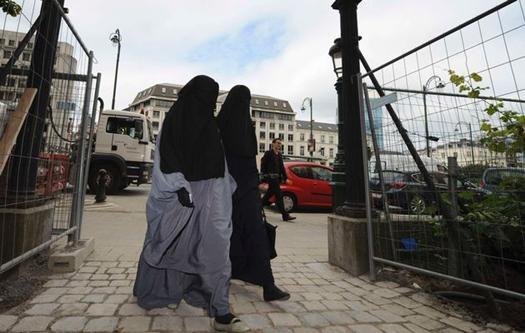
                        [COLOR=window************************]The white-haired, white-bearded Abdallah called Maria TV a victory for women who wear the niqab "after years of discrimination and injustice."[/COLOR]
                        [COLOR=window************************]Many of these women are outspoken in defending their beliefs despite criticism that they are oppressed and cloistered by patriarchal traditions.[/COLOR]
                        [COLOR=window************************]"As with everything, we got positive and negative reactions," said Islam Ahmed Abdallah, the station director's son. "But whatever. We're on our way."[/COLOR]
                        [COLOR=window************************]Executive producer, Aalaa Ahmed, who is also Abu Islam's daughter, defended the channel, saying it was time for a female team to present something for women by women.[/COLOR]
                        [COLOR=window************************]"I am reaching a sector of society has never been reached out to before," she said.[/COLOR]
                        [COLOR=window************************]Maria TV is named after the Coptic Christian slave given to the Prophet Muhammad, whom he married and freed.[/COLOR]
                        [COLOR=window************************]"I want to give children the ability to see these women and say 'I want to be like that'... to create a generation that wants this and wants to be like this," Abu Islam said[/COLOR]
                        Rep. Jesse Jackson Jr. Resigns


                        [/frame]

                        هنـــــــــــــا

                        îن îëéىهْ نçمùهْ?


                        • [frame="13 98"]

                          Chapter VIII
                          Niqab is not obligatory by Shaykh Naasiruddeen al-Albaanee

                          From the Book Jilbaab al-Mar’ah al-Muslimah Shaykh Naasiruddeen al-Albaanee the main errors of those who make the face veil obligatory
                          1. The interpretation of al-idnaa’ in the verse of the Jilbaab to mean “covering the face”. This misinterpretation is contrary to the basic meaning of the word in Arabic which is “to come close”, as is mentioned in authoritative dictionaries like al-Mufradaat by the well-known scholar, ar-Raaghib al-Asbahaanee. However, there is sufficient evidence in the interpretation of the leading commentator on the Quran, Ibn ‘Abbaas, who explained the verse saying, “She should bring the jilbaab close to her face without covering it.” It should be noted that none of the narrations used as evidence to contradict this interpretation are authentic.
                          2. The interpretation of jilbaab as “a garment which covers the face.” Like the previous misinterpretation, this interpretation has no basis linguistically. It is contrary to the interpretation of the leading scholars, past and present, who define the jilbaab as a garment which women drape over their head scarves (khimaar). Even Shaykh at-Tuwaijree himself narrated this interpretation from Ibn Mas‘ood and other Salafee scholars. Al-Baghawee mentioned it as the correct interpretation in his Tafseer (vol. 3, p. 518) saying, “It is the garment which a woman covers herself with worn above the dress (dir ‘) and the headscarf.” Ibn Hazm also said, “The jilbaab in the Arabic language in which the Messenger of Allaah () spoke to us is what covers the whole body and not just a part of it.” (vol. 3, p. 217). Al-Qurtubee declared this correct in his Tafseer and Ibn Katheer said, “It is the cloak worn above the headscarf.” (vol. 3, p. 518)
                          3. The claim that the khimaar (headscarf) covers the head and the face. In doing so “the face” has been arbitrarily added to its meaning in order to make the verse: “Let them drape their headscarves over their busoms” appear to be in their favor, when, in fact it is not. The word khimaar linguistically means only a head covering. Whenever it is mentioned in general terms, this is what is intended. For example in the hadeeths on wiping (mas-h) on the khimaar and the prophetic statement, “The salaah of a woman past puberty will not be accepted without a khimaar.” This hadeeth confirms the invalidity of their misinterpretation, because not even the extremists themselves – much less the scholars – use it as evidence that the covering of a woman’s face in salaah is a condition for its validity. They only use it as proof for covering the head. Furthermore, their interpretation of the verse of the Qawaa “to remove their clothing” to mean “jilbaab” further confirms it. They hold that it is permissible for old women to appear before marriagealbe males in her headscarf with her face exposed. One of their noteable scholars openly stated that. As for Shaykh at-Tuwaijree, he implied it without actually saying it. After checking the opinions of the early and later scholars in all the specializations, I found that they unanimously hold that the khimaar is a head covering. I have mentioned the names of more than twenty scholars, among them some of the great Imaams and hadeeth scholars. For example, Abul-Waleed al-Baajee (d. 474 AH) who further added in his explanation, “Nothing should be seen of her besides the circle of her face.”
                          4. The claim of a consensus (Ijmaa‘) on the face being considered ‘awrah. Shaykh at-Tuwaijree claimed that scholars unanimously held that the woman’s face was ‘awrah and many who have no knowledge, including some Ph.D. holders, have blindly followed him. In fact, it is a false claim, which no one before him has claimed. The books of Hambalite scholars which he learned from, not to mention those of others, contain sufficient proof of its falsehood. I have mentioned many of their statements in Ar-Radd. For example, Ibn Hubayrah al-Hambalee stated in his book, al-Ifsaah, that the face is not considered ‘awrah in the three main schools of Islaamic law and he added, “It is also a narrated position of Imaam Ahmad.” Many Hambalite scholars preferred this narration in their books, like Ibn Qudaamah and others. Ibn Qudaamah in al-Mughnee explained the reason for his preference saying, “Because necessity demands that the face be uncovered for buying and selling, and the hands be uncovered for taking and giving.” Among the Hambalite scholars, is the great Ibn Muflih al-Hambalee about whom Ibn Qayyim al-Jawziyyah said, “There is no one under the dome of the sky more knowledgeable about the school of Imaam Ahmad than Ibn Muflih.” And his teacher, Ibn Taymiyyah, once told him, “You aren’t Ibn Muflih, you are Muflih!” It is incumbent on me to convey Ibn Muflih’s statements for the readers because of the knowledge and many benefits contained in them. Included in them is further confirmation of the falsehood of Shaykh at-Tuwaijree’s claim and support for the correctness of my position on the issue of uncovering the face. Ibn Muflih stated the following in his valuable work al-Aadaab ash-Shar‘iyyah – which is among the references cited by Shaykh at-Tuwaijree (something which indicates that he is aware of it, but has deliberately hidden these crucial facts from his readers while claiming the contrary): “Is it correct to chastise marriageable women if they uncover their faces in the street? The answer depends on whether it is compulsory for women to cover their faces or whether it is compulsory for men to lower their gaze from her. There are two positions on this issue.
                          1. Regarding the hadeeth of Jareer in which he said, “I asked Allaah’s Messenger about the sudden inadvertent glance and he instructed me to look away.” Al-Qaadee ‘Iyaad commented, “The scholars, May Allaah Most High have mercy on them, have said that there is proof in this hadeeth that it is not compulsory for a woman to cover her face in the street. Instead, it is a recommended sunnah for her to do so and it is compulsory for the man to lower his gaze from her at all times, except for a legislated purpose. Shaykh Muhyud-deen an-Nawawee mentioned that without further explanation.”
                          2. Then al-Muflih mentioned Ibn Taymiyyah’s statement which at-Tuwaijree relies on in his book (page 170), while feigning ignorance of the statements of the majority of scholars. Statements like those of al-Qaadee ‘Iyaad and an-Nawawee’s agreement with it.
                          Then al-Muflih said, “On the basis of that, is chastisement legal? Chastisement is not allowed in issues in where there is a difference of opinion, and the difference has already been mentioned. As regards our opinion and that of a group of Shaafi‘ite scholars and others, looking at a marriageable woman without desire or in a secluded circumstance is permissible. Therefore, chastisement is not proper.” This answer is in complete agreement with Imaam Ahmad’s statement, “It is not proper that a jurist oblige people to follow his opinion (math-hab).” And this is if the truth were on his side. What of the case where the jurist proudly, dishonestly misleads people and declares other Muslims to be disbelievers as at-Tuwaijree did on page 249 of his book saying, “… Whoever permits women to expose their faces and uses the proofs of al-Albaanee has flung open the door for women to publicly flaunt their beauty and emboldened them to commit the reprehensible acts done by women who uncover their faces today.” And on page 233 he said, “… and to disbelief in the verses of Allaah.” Those are his words – May Allaah reform him and guide him. What would he say about Ibn Muflih, an-Nawawee, al-Qaadee ‘Iyaad and other Palestinian scholars, as well as the majority of scholars who preceded them and who are my salaf regarding my opinion on this matter?
                          5. The agreement of at-Tuwaijree and the extremists with him to explain away the authentic hadeeths which contradict their opinion. At-Tuwaijree did this with the Khath‘amiyyah hadeeth. They developed a number of comical methods to nullify its implications. I have refuted them all in ar-Radd and one of them in Jilbaab al-Mar’ah al-Muslimah. Some reputable scholars have said that the hadeeth doesn’t contain a clear statement that her face was exposed. This is among the farthest opinions from the truth. For, if her face wasn’t exposed, where did the narrator or the viewer get the idea that she was beautiful? And what was al-Fadl repeatedly looking at? The truth is that this is among the strongest and most clear proofs that a woman’s face is not ‘awrah. In spite of that, there remains a group that insists that she was in ihraam while knowing that her ihraam does not prevent her from draping some of her clothing over her face. At-Tuwaijree does accept sometimes that her face was uncovered but he cancels its implication by saying, “There is no evidence in it that she continuously exposed her face!” He means that the wind must have exposed her face and at that instant al-Fadl ibn ‘Abbaas saw it. Is it possible for an Arab to say that after reading in the hadeeth “al-Fadl began to stare while turning towards her,” and in another narration “… so he began to look at her and her beauty amazed him.” Isn’t this pride with two protruding horns? At other times at-Tuwaijree interprets it as al-Fadl looking at her size and stature.
                          6. The frequent use of inauthentic hadeeths and unreliable narrations. For example, the hadeeth of Ibn ‘Abbaas about exposing only one eye is commonly used by those who insist that women are obliged to cover their faces in spite of their knowledge of its inauthenticity. In fact, one among them also declared it inauthentic. Perhaps the most important of these unreliable hadeeth commonly used as evidence is the one in which the Prophet is reported to have said, “Are you both blind?” They blindly followed at-Tuwaijree and the others in claiming that this inauthentic narration was strengthened by other supportive narrations and that it was evidence for the prohibition of women from looking at men, even if they are blind. They took this position in spite of the fact that the narration was classified inauthentic by the leading verification experts among the hadeeth scholars like, Imaam Ahmad, al-Bayhaqee and Ibn ‘Abdil-Barr. Al-Qurtubee related that the narration was not considered authentic among the scholars of hadeeth. Consequently, many Palestinian hambalite scholars made their rulings on that basis. Furthermore, that is what the science of hadeeth and its methodology requires as was clearly stated in al-Irwaa. However, in spite of all that evidence to the contrary, Shaykh ‘Abdul-Qaadir as-Sindee had the nerve to go along with Shaykh at-Tuwaijree and others and claim that its chain of narration was authentic. By doing that he exposed himself and his ignorance or feigned ignorance. It is unfortunate that he took this position, because the hadeeth’s chain contains an unknown narrator from whom only one person narrated along with its contradiction to what leading scholars have narrated. Contrary to the level of scholarship that we are used to from Shaykh as-Sindee, he has brought in support of his claim the most amazing things. He arguments unexpectedly contain deception, misguidance, blind following, hiding knowledge and turning away from his own fundamental principles. Among the amazing positions is Shaykh as-Sindee’s feigned ignorance that the narration contradicts the hadeeth of Faatimah bint Qays which contains the Prophet’s permission for her to stay at the home of the blind companion, Ibn Umm al-Maktoom, whom she would be able see. The Prophet gave the reason for that instruction in his statement to her, “For if you take off your head scarf, he won’t see you.” In at-Tabaraanee’s narration from Faatimah, she said, “He instructed me to be at Ibn Umm Maktoom’s home because he couldn’t see me whenever I took my head scarf off.” There are also a number of other unreliable hadeeths gathered by at-Tuwaijree in his book. I mentioned ten of them in my response, and among them are some fabricated traditions.
                          7. The classification of some authentic hadeeths and confirmed narrations from the Companions as inauthentic. The extremists have declared well-established reliable narrations as unreliable and feigned ignorance of strengthening narrations. They have further declared some narrations extremely inauthentic, like the hadeeth of ‘Aa’ishah concerning the woman who reaches puberty, “Nothing should be seen of her besides her face and hands.” They have persistently declared it inauthentic – the ignorant among them blindly following others devoid of knowledge. In so doing, they contradict those among the leading scholars of hadeeth who strengthen it like al-Bayhaqee and ath-Thahabee. Most of them, including some prominent scholars, feign ignorance of its various chains of narration. In fact, at-Tuwaijree openly stated on page 236 of his book that this statement was only narrated in ‘Aa’ishah’s hadeeth. Even though he has seen with his own eyes on pages 57-9 of my book two other chains: one of which is from Asmaa bint ‘Umays and the other from Qataadah in the abbreviated (mursal) format with an authentic chain of narration. Many of the blind followers followed him, including some female authors as in Hijaabuki ukhtee al-muslimah [Your veil, my sister Muslim], page 33. They also pretend to be ignorant of the leading hadeeth scholars and others who strengthened it, like al-Munthiree, az-Zayla‘ee, al-‘Asqlaanee and ash-Shawkaanee. Some of those who promote themselves as being among the well versed in this noble science – in their forefront Shaykh as-Sindee – claim that some of its narrations are extremely weak and unreliable in order to escape from the hadeeth science rule that ‘unreliable narrations are strengthened by narrations similar to them’. In doing that, they delude their readers into thinking that no one ruled the weak narrators, like ‘Abdullaah ibn Lahee‘ah, trustworthy and that they cannot be used as supportive evidence. In doing that, they contradict the methodology of the hadeeth scholars in using supportive evidence. Among them is Imaam Ahmad and Ibn Taymiyyah – may Allaah have mercy on them. Likewise, they all feign ignorance that the scholars – among them Imaam ash-Shaafi‘ee –confirm the hadeeth mursal if most scholars use it as evidence, as is the case of ‘Aa’ishah’s hadeeth. Other strengthening factors may be added to the above. (a) The hadeeth has been narrated by Qataadah from ‘Aa’ishah. (b) It has been narrated in another chain from Asmaa. (c) All three narrators of the hadeeth ruled according to it.
                          1. Qataadah stated in his interpretation of the verse on draping, “Allaah has placed on them the requirement to cover the eyebrows,” That is, “and not on their faces” as stated by at-Tabaree.
                          2. ‘Aa’ishah said, regarding the female in ihraam, “She may drape the garment on her face, if she wishes.” This was narrated by al-Bayhaqee in an authentic chain of narrators. There is clear evidence in ‘Aa’ishah’s giving the female pilgrim a choice in draping that in her opinion the face was not ‘awrah. Otherwise she would have made it obligatory on them as those who contradict it do. Because of their position, most of the extremist authors, with at-Tuwaijree in the forefront, hid this statement of Umm al-Mu’mineen, ‘Aa’ishah from their readers. The author of Faslul-khitaab [The Definitive Statement] deliberately deleted this portion of al-Bayhaqee’s narration in his book. This being only one of a number of similar disreputable acts which I have exposed in my book. The supportive evidence is that this authentic narration from her strengthens her hadeeth from the Prophet. This is among the facts that people are unaware of or they pretend ignorance of, either choice is bitter to swallow.
                          3. As for Asmaa, it has been authentically reported from Qays ibn Abee Haazim that he saw her as a woman of white complexion with tatoos on her hands.
                          (d) The narration of Ibn ‘Abbaas earlier mentioned, “She should pull the jilbaab (cloak) close to her face without putting it on her face.” His interpretation of the verse of adornment “except what appears from it” as referring to“the face and hands” was similar. There is also a similar narration from Ibn ‘Umar to the same effect. At this point, a bitter reality must be noted due to the lessons which may be gained from it, the knowledge which it contains and is service as a reminder of the wise saying: “The truth is not know by people, know the truth and you will know people.” At the same time that Shaykh at-Tuwaijree insists on rejecting the hadeeth of ‘Aa’ishah and its supporting evidences, among them Qaatadah’s mursal narration, he willingly accepts another inauthentic hadeeth from her with mursal support. In that hadeeth it is mentioned “…that she wore a niqaab (face veil)…” and that she was supposed to have described the Prophet’s wife Safiyyah and the Ansaar women as “… a jewess among jewesses…” which is considered by scholars to be a very erroneous statement (munkar jiddan). The Shaykh argues on page 181, “It has mursal supportive evidence,” and quotes one of the mursal hadeeths of ‘Ataa containing a known liar in its chain of narration. One should reflect on the great difference between this fabricated supportive evidence and the authentic supportive evidence of Qataadah further supported by other evidences, then ask, “Why did at-Tuwaijree accept the second hadeeth of ‘Aa’ishah and not the first?” The obvious answer is that the accepted one contains reference to wearing the niqaab – even though it does not indicate obligation – while the rejected one denies it. Thus, in this regard, the Shaykh did not base his position on Islaamic legal principles, but on something similar to the Jewish principle: The ends justify the means. May Allaah help us.
                          8. Placing unreasonable conditions Among the amazing practices of some latter day blind following hanafite scholars and others is that on one hand they agree with us regarding the permissibility of women exposing their faces, because that was the position of their Imaams, but on the other hand they agree with the extremists in opposition to their Imaams. They make ijtihaad (while claiming taqleed) by adding the condition that the society be safe from fitnah to the position of the Imaams. This refers to the fitnah caused by women to men. Then one of the ignorant contemporary blind followers went to the extreme of actually attributing this “condition” to the Imaams themselves. Among some of those having no knowledge, this resulted in their concluding that there is essentially no difference between the position of the Imaams and the extremists. It is obvious to jurists that this condition is invalid because it implies that humans know something which the Lord missed knowing. That is, the temptation of women did not exist during the time of the Prophet () thus we had to create a special ruling for it which did not exist previously. In fact, the fitnah did exist during the era of divine legislation and the story of al-Fadl ibn ‘Abbaas’ trial with the Khath‘amiyyah woman and his repeated looking at her is not far from the readers’ memories. It is well known that when Allaah Most High instructed men and women to lower their gazes and instructed women to veil themselves in front of men, He did that to block the road to corruption and prevent temptation. In spite of that, He – Most Great and Glorious – did not command that they cover their faces and hands in front of them. The Prophet () further emphasized that in the story of al-Fadl by not commanding the woman to cover her face. And Allaah was truthful when He said, “And your Lord is not forgetful” </B>The reality is that the condition of there not being fitnah was only mentioned by scholars regarding the man’s looking at the woman’s face, as in al-Fiqh ‘alaa al-mathaahib al-arba‘ah, page 12. They said, “That [the woman’s face may be uncovered] is permissible on condition that there is safety from temptation,” and that is true, contrary to what the blind followers practice. They conclude from it that the woman is obliged to cover her face, when in fact it is not a necessary consequence. They know that the condition of safety from temptation also applies to women. For it is not permissible for them to stare at a man’s face except where there is safety from temptation. Is it then a necessary consequence that men also veil their faces from women to prevent temptation as some tribes called the Tawareg do. They would have a basis in fiqh of the Quraan and Sunnah if they said that a woman veiled in correct jilbaab who fears being harmed by some corrupt individuals due to her face being exposed is obliged to cover her face to prevent harm and temptation. In fact, it could even be said that it is obligatory on her not to leave her home if she feared that some evil authorities supported by a leader who does not rule by what Allaah revealed, as exists in some Arab countries since a few years ago, would pull her jilbaab from her head. As to making this obligation a compulsory law for all women everywhere and in all eras, even if there did not exist any harm for veiled women, No. Absolutely not. Allaah was truthful when He said, “Do they have partners who legislated for them in the religion what Allaah did not permit??” These are the most significant of the extremist opposition’s mistakes which I thought needed brief mention due their strong link to the contents of this book. I then closed ar-Radd al-Mufhim with a reminder that extremism in the religion – considering that the Wise Legislator forbade it will not bring any good. And it is not possible for it to produce a generation of young Muslim women carrying Islaamic knowledge and practice moderately balanced, with neither excesses nor deficiencies. Not like what I have heard about some young female adherents in Arab countries when they heard the Prophet’s statement, “The woman in ihraam should neither wear a niqaab nor gloves,” they did not accept it saying instead, “We will wear our niqaabs and gloves!” No doubt, this was a direct result of the extremist views which they heard regarding the obligation of covering their faces. I certainly cannot imagine that this type of extremism – and this is only one example from many which I have – can possibly produce for us salafee women able to do everything their religiously guided social life demands of them in a way similar to the righteous women of the Salaf.


                          [/frame]

                          هنـــــــــــــا

                          îن îëéىهْ نçمùهْ?


                          • [frame="13 98"]

                            <STYLE><!--.ExternalClass .ecxhmmessage P{padding:0px;}.ExternalClass body.ecxhmmessage{font-size:10pt;font-family:Tahoma;}--></STYLE>
                            Chapter IX
                            Men in Islam versus Women in the Judaeo-Christian Tradition

                            INTRODUCTION


                            [COLOR=window************************]Five years ago, I read in the Toronto Star issue of July 3, 1990 an article titled "Islam is not alone in patriarchal doctrines", by Gwynne Dyer. The article described the furious reactions of the participants of a conference on women and power held in Montreal to the comments of the famous Egyptian feminist Dr. Nawal Saadawi. Her "politically incorrect" statements included : "the most restrictive elements towards women can be found first in Judaism in the Old Testament then in Christianity and then in the Quran"; "all religions are patriarchal because they stem from patriarchal societies"; and "veiling of women is not a specifically Islamic practice but an ancient cultural heritage with analogies in sister religions". The participants could not bear sitting around while their faiths were being equated with Islam. Thus, Dr. Saadawi received a barrage of criticism. "Dr. Saadawi's comments are unacceptable. Her answers reveal a lack of understanding about other people's faiths," declared Bernice Dubois of the World Movement of Mothers. "I must protest" said panellist Alice Shalvi of Israel women's network, "there is no conception of the veil in Judaism." The article attributed these furious protests to the strong tendency in the West to scapegoat Islam for practices that are just as much a part of the West's own cultural heritage. "Christian and Jewish feminists were not going to sit around being discussed in the same category as those wicked Muslims," wrote Gwynne Dyer. [/COLOR]
                            [COLOR=window************************]I was not surprised that the conference participants had held such a negative view of Islam, especially when women's issues were involved. In the West, Islam is believed to be the symbol of the subordination of women par excellence. In order to understand how firm this belief is, it is enough to mention that the Minister of Education in France, the land of Voltaire, has recently ordered the expulsion of all young Muslim women wearing the veil from French schools!1 A young Muslim student wearing a headscarf is denied her right of education in France, while a Catholic student wearing a cross or a Jewish student wearing a skullcap is not. The scene of French policemen preventing young Muslim women wearing headscarves from entering their high school is unforgettable. It inspires the memories of another equally disgraceful scene of Governor George Wallace of Alabama in 1962 standing in front of a school gate trying to block the entrance of black students in order to prevent the desegregation of Alabama's schools. The difference between the two scenes is that the black students had the sympathy of so many people in the U.S. and in the whole world. President Kennedy sent the U.S. National Guard to force the entry of the black students. The Muslim girls, on the other hand, received no help from any one. Their cause seems to have very little sympathy either inside or outside France. The reason is the widespread misunderstanding and fear of anything Islamic in the world today. [/COLOR]
                            [COLOR=window************************]What intrigued me the most about the Montreal conference was one question: Were the statements made by Saadawi, or any of her critics, factual ? In other words, do Judaism, Christianity, and Islam have the same conception of women? Are they different in their conceptions ? Do Judaism and Christianity , truly, offer women a better treatment than Islam does? What is the Truth? [/COLOR]
                            [COLOR=window************************]It is not easy to search for and find answers to these difficult questions. The first difficulty is that one has to be fair and objective or, at least, do one's utmost to be so. This is what Islam teaches. The Quran has instructed Muslims to say the truth even if those who are very close to them do not like it: "Whenever you speak, speak justly, even if a near relative is concerned" (6:152) "O you who believe stand out firmly for justice, as witnesses to Allah, even as against yourselves, or your parents or your kin, and whether it be (against) rich or poor" (4:135). [/COLOR]
                            [COLOR=window************************]The other great difficulty is the overwhelming breadth of the subject. Therefore, during the last few years, I have spent many hours reading the Bible, The Encyclopaedia of Religion, and the Encyclopaedia Judaica searching for answers. I have also read several books discussing the position of women in different religions written by scholars, apologists, and critics. The material presented in the following chapters represents the important findings of this humble research. I don't claim to be absolutely objective. This is beyond my limited capacity. All I can say is that I have been trying, throughout this research, to approach the Quranic ideal of "speaking justly". [/COLOR]
                            [COLOR=window************************]I would like to emphasize in this introduction that my purpose for this study is not to denigrate Judaism or Christianity. As Muslims, we believe in the divine origins of both. No one can be a Muslim without believing in Moses and Jesus as great prophets of God. My goal is only to vindicate Islam and pay a tribute, long overdue in the West, to the final truthful Message from God to the human race. I would also like to emphasize that I concerned myself only with Doctrine. That is, my concern is, mainly, the position of women in the three religions as it appears in their original sources not as practised by their millions of followers in the world today. Therefore, most of the evidence cited comes from the Quran, the sayings of Prophet Muhammad, the Bible, the Talmud, and the sayings of some of the most influential Church Fathers whose views have contributed immeasurably to defining and shaping Christianity. This interest in the sources relates to the fact that understanding a certain religion from the attitudes and the behaviour of some of its nominal followers is misleading. Many people confuse culture with religion, many others do not know what their religious books are saying, and many others do not even care. [/COLOR]
                            EVE'S FAULT ?
                            [COLOR=window************************]The three religions agree on one basic fact: Both women and men are created by God, The Creator of the whole universe. However, disagreement starts soon after the creation of the first man, Adam, and the first woman, Eve. The Judaeo-Christian conception of the creation of Adam and Eve is narrated in detail in Genesis 2:4-3:24. God prohibited both of them from eating the fruits of the forbidden tree. The serpent seduced Eve to eat from it and Eve, in turn, seduced Adam to eat with her. When God rebuked Adam for what he did, he put all the blame on Eve, "The woman you put here with me --she gave me some fruit from the tree and I ate it." Consequently, God said to Eve: [/COLOR]
                            [COLOR=window************************]"I will greatly increase your pains in childbearing; with pain you will give birth to children. Your desire will be for your husband and he will rule over you." [/COLOR]
                            [COLOR=window************************]To Adam He said: [/COLOR]
                            [COLOR=window************************]"Because you listened to your wife and ate from the tree .... Cursed is the ground because of you; through painful toil you will eat of it all the days of your life..." [/COLOR]
                            [COLOR=window************************]The Islamic conception of the first creation is found in several places in the Quran, for example: [/COLOR]
                            [COLOR=window************************]"O Adam dwell with your wife in the Garden and enjoy as you wish but approach not this tree or you run into harm and transgression. Then Satan whispered to them in order to reveal to them their shame that was hidden from them and he said: 'Your Lord only forbade you this tree lest you become angels or such beings as live forever.' And he swore to them both that he was their sincere adviser. So by deceit he brought them to their fall: when they tasted the tree their shame became manifest to them and they began to sew together the leaves of the Garden over their bodies. And their Lord called unto them: 'Did I not forbid you that tree and tell you that Satan was your avowed enemy?' They said: 'Our Lord we have wronged our own souls and if You forgive us not and bestow not upon us Your Mercy, we shall certainly be lost' " (7:19:23). [/COLOR]
                            [COLOR=window************************]A careful look into the two accounts of the story of the Creation reveals some essential differences. The Quran, contrary to the Bible, places equal blame on both Adam and Eve for their mistake. Nowhere in the Quran can one find even the slightest hint that Eve tempted Adam to eat from the tree or even that she had eaten before him. Eve in the Quran is no temptress, no seducer, and no deceiver. Moreover, Eve is not to be blamed for the pains of childbearing. God, according to the Quran, punishes no one for another's faults. Both Adam and Eve committed a sin and then asked God for forgiveness and He forgave them both. [/COLOR]
                            EVE'S LEGACY
                            [COLOR=window************************]The image of Eve as temptress in the Bible has resulted in an extremely negative impact on women throughout the Judaeo-Christian tradition. All women were believed to have inherited from their mother, the Biblical Eve, both her guilt and her guile. Consequently, they were all untrustworthy, morally inferior, and wicked. Menstruation, pregnancy, and childbearing were considered the just punishment for the eternal guilt of the cursed female sex. In order to appreciate how negative the impact of the Biblical Eve was on all her female descendants we have to look at the writings of some of the most important Jews and Christians of all time. Let us start with the Old Testament and look at excerpts from what is called the Wisdom Literature in which we find: [/COLOR]
                            [COLOR=window************************]"I find more bitter than death the woman who is a snare, whose heart is a trap and whose hands are chains. The man who pleases God will escape her, but the sinner she will ensnare....while I was still searching but not finding, I found one upright man among a thousand but not one upright woman among them all" (Ecclesiastes 7:26-28). [/COLOR]
                            [COLOR=window************************]In another part of the Hebrew literature which is found in the Catholic Bible we read: [/COLOR]
                            [COLOR=window************************]"No wickedness comes anywhere near the wickedness of a woman.....Sin began with a woman and thanks to her we all must die" (Ecclesiasticus 25:19,24). [/COLOR]
                            [COLOR=window************************]Jewish Rabbis listed nine curses inflicted on women as a result of the Fall: [/COLOR]
                            [COLOR=window************************]"To the woman He gave nine curses and death: the burden of the blood of menstruation and the blood of virginity; the burden of pregnancy; the burden of childbirth; the burden of bringing up the children; her head is covered as one in mourning; she pierces her ear like a permanent slave or slave girl who serves her master; she is not to be believed as a witness; and after everything--death." 2 [/COLOR]
                            [COLOR=window************************]To the present day, orthodox Jewish men in their daily morning prayer recite "Blessed be God King of the universe that Thou has not made me a woman." The women, on the other hand, thank God every morning for "making me according to Thy will." 3 Another prayer found in many Jewish prayer books: "Praised be God that he has not created me a gentile. Praised be God that he has not created me a woman. Praised be God that he has not created me an ignoramus." 4 [/COLOR]
                            [COLOR=window************************]The Biblical Eve has played a far bigger role in Christianity than in Judaism. Her sin has been pivotal to the whole Christian faith because the Christian conception of the reason for the mission of Jesus Christ on Earth stems from Eve's disobedience to God. She had sinned and then seduced Adam to follow her suit. Consequently, God expelled both of them from Heaven to Earth, which had been cursed because of them. They bequeathed their sin, which had not been forgiven by God, to all their descendants and, thus, all humans are born in sin. In order to purify human beings from their 'original sin', God had to sacrifice Jesus, who is considered to be the Son of God, on the cross. Therefore, Eve is responsible for her own mistake, her husband's sin, the original sin of all humanity, and the death of the Son of God. In other words, one woman acting on her own caused the fall of humanity. 5 What about her daughters? They are sinners like her and have to be treated as such. Listen to the severe tone of St. Paul in the New Testament: [/COLOR]
                            [COLOR=window************************]"A woman should learn in quietness and full submission. I don't permit a woman to teach or to have authority over a man; she must be silent. For Adam was formed first, then Eve. And Adam was not the one deceived; it was the woman who was deceived and became a sinner" (I Timothy 2:11-14). [/COLOR]
                            [COLOR=window************************]St. Tertullian was even more blunt than St. Paul, while he was talking to his 'best beloved sisters' in the faith, he said: 6 [/COLOR]
                            [COLOR=window************************]"Do you not know that you are each an Eve? The sentence of God on this sex of yours lives in this age: the guilt must of necessity live too. You are the Devil's gateway: You are the unsealer of the forbidden tree: You are the first deserter of the divine law: You are she who persuaded him whom the devil was not valiant enough to attack. You destroyed so easily God's image, man. On account of your desert even the Son of God had to die." [/COLOR]
                            [COLOR=window************************]St. Augustine[/COLOR][COLOR=window************************] was faithful to the legacy of his predecessors, he wrote to a friend: [/COLOR]
                            [COLOR=window************************]"What is the difference whether it is in a wife or a mother, it is still Eve the temptress that we must beware of in any woman......I fail to see what use woman can be to man, if one excludes the function of bearing children." [/COLOR]
                            [COLOR=window************************]Centuries later, St. Thomas Aquinas still considered women as defective: [/COLOR]
                            [COLOR=window************************]"As regards the individual nature, woman is defective and misbegotten, for the active force in the male seed tends to the production of a perfect likeness in the masculine sex; while the production of woman comes from a defect in the active force or from some material indisposition, or even from some external influence." [/COLOR]
                            [COLOR=window************************]Finally, the renowned reformer Martin Luther could not see any benefit from a woman but bringing into the world as many children as possible regardless of any side effects: [/COLOR]
                            [COLOR=window************************]"If they become tired or even die, that does not matter. Let them die in childbirth, that's why they are there" [/COLOR]
                            [COLOR=window************************]Again and again all women are denigrated because of the image of Eve the temptress, thanks to the Genesis account. To sum up, the Judaeo-Christian conception of women has been poisoned by the belief in the sinful nature of Eve and her female offspring. [/COLOR]
                            [COLOR=window************************]If we now turn our attention to what the Quran has to say about women, we will soon realize that the Islamic conception of women is radically different from the Judaeo-Christian one. Let the Quran speak for itself: [/COLOR]
                            [COLOR=window************************]"For Muslim men and women, for believing men and women, for devout men and women, for true men and women, for men and women who are patient, for men and women who humble themselves, for men and women who give in charity, for men and women who fast, for men and women who guard their chastity, and for men and women who engage much in Allah's praise-- For them all has Allah prepared forgiveness and great reward" (33:35). [/COLOR]
                            [COLOR=window************************]"The believers, men and women, are protectors, one of another: they enjoin what is just, and forbid what is evil, they observe regular prayers, practise regular charity, and obey Allah and His Messenger. On them will Allah pour His Mercy: for Allah is Exalted in power, Wise" (9:71). [/COLOR]
                            [COLOR=window************************]"And their Lord answered them: Truly I will never cause to be lost the work of any of you, Be you a male or female, you are members one of another" (3:195). [/COLOR]
                            [COLOR=window************************]"Whoever works evil will not be requited but by the like thereof, and whoever works a righteous deed -whether man or woman- and is a believer- such will enter the Garden of bliss" (40:40). [/COLOR]
                            [COLOR=window************************]"Whoever works righteousness, man or woman, and has faith, verily to him/her we will give a new life that is good and pure, and we will bestow on such their reward according to the best of their actions" (16:97). [/COLOR]
                            [COLOR=window************************]It is clear that the Quranic view of women is no different than that of men. They, both, are God's creatures whose sublime goal on earth is to worship their Lord, do righteous deeds, and avoid evil and they, both, will be assessed accordingly. The Quran never mentions that the woman is the devil's gateway or that she is a deceiver by nature. The Quran, also, never mentions that man is God's image; all men and all women are his creatures, which are all. According to the Quran, a woman's role on earth is not limited only to childbirth. She is required to do as many good deeds as any other man is required to do. The Quran never says that no upright women have ever existed. To the contrary, the Quran has instructed all the believers, women as well as men, to follow the example of those ideal women such as the Virgin Mary and the Pharoah's wife: [/COLOR]
                            [COLOR=window************************]"And Allah sets forth, As an example to those who believe, the wife of Pharaoh: Behold she said: 'O my lord build for me, in nearness to you, a mansion in the Garden, and save me from Pharaoh and his doings and save me from those who do wrong.' And Mary the daughter of Imran who guarded her chastity and We breathed into her body of Our spirit; and she testified to the truth of the words of her Lord and of His revelations and was one of the devout" (66:11-13). [/COLOR]
                            SHAMEFUL DAUGHTERS?
                            [COLOR=window************************]In fact, the difference between the Biblical and the Quranic attitude towards the female sex starts as soon as a female is born. For example, the Bible states that the period of the mother's ritual impurity is twice as long if a girl is born than if a boy is (Lev. 12:2-5). The Catholic Bible states explicitly that: [/COLOR]
                            [COLOR=window************************]"The birth of a daughter is a loss" (Ecclesiasticus 22:3). [/COLOR]
                            [COLOR=window************************]In contrast to this shocking statement, boys receive special praise: [/COLOR]
                            [COLOR=window************************]"A man who educates his son will be the envy of his enemy." (Ecclesiasticus 30:3) [/COLOR]
                            [COLOR=window************************]Jewish Rabbis made it an obligation on Jewish men to produce offspring in order to propagate the race. At the same time, they did not hide their clear preference for male children : "It is well for those whose children are male but ill for those whose are female", "At the birth of a boy, all are joyful...at the birth of a girl all are sorrowful", and "When a boy comes into the world, peace comes into the world... When a girl comes, nothing comes."7 [/COLOR]
                            [COLOR=window************************]A daughter is considered a painful burden, a potential source of shame to her father: [/COLOR]
                            [COLOR=window************************]"Your daughter is headstrong? Keep a sharp look-out that she does not make you the laughing stock of your enemies, the talk of the town, the object of common gossip, and put you to public shame" (Ecclesiasticus 42:11). [/COLOR]
                            [COLOR=window************************]"Keep a headstrong daughter under firm control, or she will abuse any indulgence she receives. Keep a strict watch on her shameless eye, do not be surprised if she disgraces you" (Ecclesiasticus 26:10-11). [/COLOR]
                            [COLOR=window************************]It was this very same idea of treating daughters as sources of shame that led the pagan Arabs, before the advent of Islam, to practice female infanticide. The Quran severely condemned this heinous practice: [/COLOR]
                            [COLOR=window************************]"When news is brought to one of them of the birth of a female child, his face darkens and he is filled with inward grief. With shame does he hide himself from his people because of the bad news he has had! Shall he retain her on contempt or bury her in the dust? Ah! what an evil they decide on?" (16:59). [/COLOR]
                            [COLOR=window************************]It has to be mentioned that this sinister crime would have never stopped in Arabia were it not for the power of the scathing terms the Quran used to condemn this practice (16:59, 43:17, 81:8-9). The Quran, moreover, makes no distinction between boys and girls. In contrast to the Bible, the Quran considers the birth of a female as a gift and a blessing from God, the same as the birth of a male. The Quran even mentions the gift of the female birth first: [/COLOR]
                            [COLOR=window************************]" To Allah belongs the dominion of the heavens and the earth. He creates what He wills. He bestows female children to whomever He wills and bestows male children to whomever He wills" (42:49). [/COLOR]
                            [COLOR=window************************]In order to wipe out all the traces of female infanticide in the nascent Muslim society, Prophet Muhammad promised those who were blessed with daughters of a great reward if they would bring them up kindly: [/COLOR]
                            [COLOR=window************************]"He who is involved in bringing up daughters, and accords benevolent treatment towards them, they will be protection for him against Hell-Fire" (Bukhari and Muslim). [/COLOR]
                            [COLOR=window************************]"Whoever maintains two girls till they attain maturity, he and I will come on the Resurrection Day like this; and he joined his fingers" (Muslim). [/COLOR]
                            FEMALE EDUCATION?
                            [COLOR=window************************]The difference between the Biblical and the Quranic conceptions of women is not limited to the newly born female, it extends far beyond that. Let us compare their attitudes towards a female trying to learn her religion. The heart of Judaism is the Torah, the law. However, according to the Talmud, "women are exempt from the study of the Torah." Some Jewish Rabbis firmly declared "Let the words of Torah rather be destroyed by fire than imparted to women", and "Whoever teaches his daughter Torah is as though he taught her obscenity"8 [/COLOR]
                            [COLOR=window************************]The attitude of St. Paul in the New Testament is not brighter: [/COLOR]
                            [COLOR=window************************]"As in all the congregations of the saints, women should remain silent in the churches. They are not allowed to speak, but must be in submission as the law says. If they want to inquire about something, they should ask their own husbands at home; for it is disgraceful for a woman to speak in the church." (I Corinthians 14:34-35) [/COLOR]
                            [COLOR=window************************]How can a woman learn if she is not allowed to speak? How can a woman grow intellectually if she is obliged to be in a state of full submission? How can she broaden her horizons if her one and only source of information is her husband at home? [/COLOR]
                            [COLOR=window************************]Now, to be fair, we should ask: is the Quranic position any different? One short story narrated in the Quran sums its position up concisely. Khawlah was a Muslim woman whose husband Aws pronounced this statement at a moment of anger: "You are to me as the back of my mother." This was held by pagan Arabs to be a statement of divorce which freed the husband from any conjugal responsibility but did not leave the wife free to leave the husband's home or to marry another man. Having heard these words from her husband, Khawlah was in a miserable situation. She went straight to the Prophet of Islam to plead her case. The Prophet was of the opinion that she should be patient since there seemed to be no way out. Khawla kept arguing with the Prophet in an attempt to save her suspended marriage. Shortly, the Quran intervened; Khawla's plea was accepted. The divine verdict abolished this iniquitous custom. One full chapter (Chapter 58) of the Quran whose title is "Almujadilah" or "The woman who is arguing" was named after this incident: [/COLOR]
                            [COLOR=window************************]"Allah has heard and accepted the statement of the woman who pleads with you (the Prophet) concerning her husband and carries her complaint to Allah, and Allah hears the arguments between both of you for Allah hears and sees all things...." (58:1). [/COLOR]
                            [COLOR=window************************]A woman in the Quranic conception has the right to argue even with the Prophet of Islam himself. No one has the right to instruct her to be silent. She is under no obligation to consider her husband the one and only reference in matters of law and religion. [/COLOR]
                            UNCLEAN IMPURE WOMAN?


                            [/frame]

                            هنـــــــــــــا

                            îن îëéىهْ نçمùهْ?


                            • [frame="13 98"]

                              <STYLE><!--.ExternalClass .ecxhmmessage P{padding:0px;}.ExternalClass body.ecxhmmessage{font-size:10pt;font-family:Tahoma;}--></STYLE>
                              UNCLEAN IMPURE WOMAN?
                              [COLOR=window************************]Jewish laws and regulations concerning menstruating women are extremely restrictive. The Old Testament considers any menstruating woman as unclean and impure. Moreover, her impurity "infects" others as well. Anyone or anything she touches becomes unclean for a day: [/COLOR]
                              [COLOR=window************************]"When a woman has her regular flow of blood, the impurity of her monthly period will last seven days, and anyone who touches her will be unclean till evening. Anything she lies on during her period will be unclean, and anything she sits on will be unclean. Whoever touches her bed must wash his clothes and bathe with water, and he will be unclean till evening. Whoever touches anything she sits on must wash his clothes and bathe with water, and he will be unclean till evening. Whether it is the bed or anything she was sitting on, when anyone touches it, he will be unclean till evening" (Lev. 15:19-23). [/COLOR]
                              [COLOR=window************************]Due to her "contaminating" nature, a menstruating woman was sometimes "banished" in order to avoid any possibility of any contact with her. She was sent to a special house called "the house of uncleanness" for the whole period of her impurity. 9 The Talmud considers a menstruating woman "fatal" even without any physical contact: [/COLOR]
                              [COLOR=window************************]"Our Rabbis taught:....if a menstruant woman passes between two (men), if it is at the beginning of her menses she will slay one of them, and if it is at the end of her menses she will cause strife between them" (bPes. 111a.) [/COLOR]
                              [COLOR=window************************]Furthermore, the husband of a menstruous woman was forbidden to enter the synagogue if he had been made unclean by her even by the dust under her feet. A priest whose wife, daughter, or mother was menstruating could not recite priestly blessing in the synagogue. 10 No wonder many Jewish women still refer to menstruation as "the curse." 11 [/COLOR]
                              [COLOR=window************************]Islam does not consider a menstruating woman to possess any kind of "contagious uncleanness". She is neither "untouchable" nor "cursed." She practises her normal life with only one restriction: A married couple are not allowed to have sexual intercourse during the period of menstruation. Any other physical contact between them is permissible. A menstruating woman is exempted from some rituals such as daily prayers and fasting during her period. [/COLOR]
                              BEARING WITNESS
                              [COLOR=window************************]Another issue in which the Quran and the Bible disagree is the issue of women bearing witness. It is true that the Quran has instructed the believers dealing in financial transactions to get two male witnesses or one male and two females (2:282). However, it is also true that the Quran in other situations accepts the testimony of a woman as equal to that of a man. In fact the woman's testimony can even invalidate the man's. If a man accuses his wife of unchastity, he is required by the Quran to solemnly swear five times as evidence of the wife's guilt. If the wife denies and swears similarly five times, she is not considered guilty and in either case the marriage is dissolved (24:6-11). [/COLOR]
                              [COLOR=window************************]On the other hand, women were not allowed to bear witness in early Jewish society. 12 The Rabbis counted women's not being able to bear witness among the nine curses inflicted upon all women because of the Fall (see the "Eve's Legacy" section). Women in today's Israel are not allowed to give evidence in Rabbinical courts. 13 The Rabbis justify why women cannot bear witness by citing Genesis 18:9-16, where it is stated that Sara, Abraham's wife had lied. The Rabbis use this incident as evidence that women are unqualified to bear witness. It should be noted here that this story narrated in Genesis 18:9-16 has been mentioned more than once in the Quran without any hint of any lies by Sara (11:69-74, 51:24-30). In the Christian West, both ecclesiastical and civil law debarred women from giving testimony until late last century. 14 [/COLOR]
                              [COLOR=window************************]If a man accuses his wife of unchastity, her testimony will not be considered at all according to the Bible. The accused wife has to be subjected to a trial by ordeal. In this trial, the wife faces a complex and humiliating ritual which was supposed to prove her guilt or innocence (Num. 5:11-31). If she is found guilty after this ordeal, she will be sentenced to death. If she is found not guilty, her husband will be innocent of any wrongdoing. [/COLOR]
                              [COLOR=window************************]Besides, if a man takes a woman as a wife and then accuses her of not being a virgin, her own testimony will not count. Her parents had to bring evidence of her virginity before the elders of the town. If the parents could not prove the innocence of their daughter, she would be stoned to death on her father's doorsteps. If the parents were able to prove her innocence, the husband would only be fined one hundred shekels of silver and he could not divorce his wife as long as he lived: [/COLOR]
                              [COLOR=window************************]"If a man takes a wife and, after lying with her, dislikes her and slanders her and gives her a bad name, saying, 'I married this woman, but when I approached her, I did not find proof of her virginity,' then the girl's father and mother shall bring proof that she was a virgin to the town elders at the gate. The girl's father will say to the elders, 'I gave my daughter in marriage to this man, but he dislikes her. Now he has slandered her and said I did not find your daughter to be a virgin. But here is the proof of my daughter's virginity.' Then her parents shall display the cloth before the elders of the town, and the elders shall take the man and punish him. They shall fine him a hundred shekels of silver and give them to the girl's father, because this man has given an Israelite virgin a bad name. She shall continue to be his wife; he must not divorce her as long as he lives. If, however, the charge is true and no proof of the girl's virginity can be found, she shall be brought to the door of her father's house and there the men of the town shall stone her to death. She has done a disgraceful thing in Israel by being promiscuous while still in her father's house. You must purge the evil from among you." (Deuteronomy 22:13-21)[/COLOR]
                              [COLOR=window************************][/COLOR]
                              ADULTERY
                              [COLOR=window************************]Adultery is considered a sin in all religions. The Bible decrees the death sentence for both the adulterer and the adulteress (Lev. 20:10). Islam also equally punishes both the adulterer and the adulteress (24:2). However, the Quranic definition of adultery is very different from the Biblical definition. Adultery, according to the Quran, is the involvement of a married man or a married woman in an extramarital affair. The Bible only considers the extramarital affair of a married woman as adultery (Leviticus 20:10, Deuteronomy 22:22, Proverbs 6:20-7:27). [/COLOR]
                              [COLOR=window************************]"If a man is found sleeping with another man's wife, both the man who slept with her and the woman must die. You must purge the evil from Israel" (Deut. 22:22). [/COLOR]
                              [COLOR=window************************]"If a man commits adultery with another man's wife both the adulterer and the adulteress must be put to death" (Lev. 20:10). [/COLOR]
                              [COLOR=window************************]According to the Biblical definition, if a married man sleeps with an unmarried woman, this is not considered a crime at all. The married man who has extramarital affairs with unmarried women is not an adulterer and the unmarried women involved with him are not adulteresses. The crime of adultery is committed only when a man, whether married or single, sleeps with a married woman. In this case the man is considered adulterer, even if he is not married, and the woman is considered adulteress. In short, adultery is any illicit sexual intercourse involving a married woman. The extramarital affair of a married man is not per se a crime in the Bible. Why is the dual moral standard? According to Encyclopaedia Judaica, the wife was considered to be the husband's possession and adultery constituted a violation of the husband's exclusive right to her; the wife as the husband's possession had no such right to him. 15 That is, if a man had sexual intercourse with a married woman, he would be violating the property of another man and, thus, he should be punished. [/COLOR]
                              [COLOR=window************************]To the present day in Israel, if a married man indulges in an extramarital affair with an unmarried woman, his children by that woman are considered legitimate. But, if a married woman has an affair with another man, whether married or not married, her children by that man are not only illegitimate but they are considered bastards and are forbidden to marry any other Jews except converts and other bastards. This ban is handed down to the children's descendants for 10 generations until the taint of adultery is presumably weakened. 16 [/COLOR]
                              [COLOR=window************************]The Quran, on the other hand, never considers any woman to be the possession of any man. The Quran eloquently describes the relationship between the spouses by saying: [/COLOR]
                              [COLOR=window************************]" And among His signs is that He created for you mates from among yourselves, that you may dwell in tranquillity with them and He has put love and mercy between your hearts: verily in that are signs for those who reflect" (30:21). [/COLOR]
                              [COLOR=window************************]This is the Quranic conception of marriage: love, mercy, and tranquillity, not possession and double standards. [/COLOR]
                              VOWS
                              [COLOR=window************************]According to the Bible, a man must fulfil any vows he might make to God. He must not break his word. On the other hand, a woman's vow is not necessarily binding on her. It has to be approved by her father, if she is living in his house, or by her husband, if she is married. If a father/husband does not endorse his daughter's/wife's vows, all pledges made by her become null and void: [/COLOR]
                              [COLOR=window************************]"But if her father forbids her when he hears about it, none of her vows or the pledges by which she obligated herself will stand ....Her husband may confirm or nullify any vow she makes or any sworn pledge to deny herself" (Num. 30:2-15) [/COLOR]
                              [COLOR=window************************]Why is it that a woman's word is not binding per se ? The answer is simple: because she is owned by her father, before marriage, or by her husband after marriage. The father's control over his daughter was absolute to the extent that, should he wish, he could sell her! It is indicated in the writings of the Rabbis that: "The man may sell his daughter, but the woman may not sell her daughter; the man may betroth his daughter, but the woman may not betroth her daughter." 17 The Rabbinic literature also indicates that marriage represents the transfer of control from the father to the husband: "betrothal, making a woman the sacrosanct possession--the inviolable property-- of the husband..." Obviously, if the woman is considered to be the property of someone else, she cannot make any pledges that her owner does not approve of. [/COLOR]
                              [COLOR=window************************]It is of interest to note that this Biblical instruction concerning women's vows has had negative repercussions on Judaeo-Christian women till early in this century. A married woman in the Western world had no legal status. No act of hers was of any legal value. Her husband could repudiate any contract, bargain, or deal she had made. Women in the West (the largest heir of the Judaeo-Christian legacy) were held unable to make a binding contract because they were practically owned by someone else. Western women had suffered for almost two thousand years because of the Biblical attitude towards women's position vis-à-vis their fathers and husbands. 18 [/COLOR]
                              [COLOR=window************************]In Islam, the vow of every Muslim, male or female, is binding on him/her. No one has the power to repudiate the pledges of anyone else. Failure to keep a solemn oath, made by a man or a woman, has to be expiated as indicated in the Quran: [/COLOR]
                              [COLOR=window************************]"He [God] will call you to account for your deliberate oaths: for expiation, feed ten indigent persons, on a scale of the average for the food of your families; Or clothe them; or give a slave his freedom. If that is beyond your means, fast for three days. That is the expiation for the oaths you have sworn. But keep your oaths" (5:89). [/COLOR]
                              [COLOR=window************************]Companions of the Prophet Muhammad, men and women, used to present their oath of allegiance to him personally. Women, as well as men, would independently come to him and pledge their oaths: [/COLOR]
                              [COLOR=window************************]"O Prophet, When believing women come to you to make a covenant with you that they will not associate in worship anything with God, nor steal, nor fornicate, nor kill their own children, nor slander anyone, nor disobey you in any just matter, then make a covenant with them and pray to God for the forgiveness of their sins. Indeed God is Forgiving and most Merciful" (60:12). [/COLOR]
                              [COLOR=window************************]A man could not swear the oath on behalf of his daughter or his wife. Nor could a man repudiate the oath made by any of his female relatives. [/COLOR]
                              WIFE'S PROPERTY?
                              [COLOR=window************************]The three religions share an unshakeable belief in the importance of marriage and family life. They also agree on the leadership of the husband over the family. Nevertheless, blatant differences do exist among the three religions with respect to the limits of this leadership. The Judaeo-Christian tradition, unlike Islam, virtually extends the leadership of the husband into ownership of his wife. [/COLOR]
                              [COLOR=window************************]The Jewish tradition regarding the husband's role towards his wife stems from the conception that he owns her as he owns his slave. 19 This conception has been the reason behind the double standard in the laws of adultery and behind the husband's ability to annul his wife's vows. This conception has also been responsible for denying the wife any control over her property or her earnings. As soon as a Jewish woman got married, she completely lost any control over her property and earnings to her husband. Jewish Rabbis asserted the husband's right to his wife's property as a corollary of his possession of her: "Since one has come into the possession of the woman does it not follow that he should come into the possession of her property too?", and "Since he has acquired the woman should he not acquire also her property?" 20 Thus, marriage caused the richest woman to become practically penniless. The Talmud describes the financial situation of a wife as follows: [/COLOR]
                              [COLOR=window************************]"How can a woman have anything; whatever is hers belongs to her husband? What is his is his and what is hers is also his...... Her earnings and what she may find in the streets are also his. The household articles, even the crumbs of bread on the table, are his. Should she invite a guest to her house and feed him, she would be stealing from her husband..." (San. 71a, Git. 62a) [/COLOR]
                              [COLOR=window************************]The fact of the matter is that the property of a Jewish female was meant to attract suitors. A Jewish family would assign their daughter a share of her father's estate to be used as a dowry in case of marriage. It was this dowry that made Jewish daughters an unwelcome burden to their fathers. The father had to raise his daughter for years and then prepare for her marriage by providing a large dowry. Thus, a girl in a Jewish family was a liability and no asset. 21 This liability explains why the birth of a daughter was not celebrated with joy in the old Jewish society (see the "Shameful Daughters?" section). The dowry was the wedding gift presented to the groom under terms of tenancy. The husband would act as the practical owner of the dowry but he could not sell it. The bride would lose any control over the dowry at the moment of marriage. Moreover, she was expected to work after marriage and all her earnings had to go to her husband in return for her maintenance which was his obligation. She could regain her property only in two cases: divorce or her husband's death. Should she die first, he would inherit her property. In the case of the husband's death, the wife could regain her pre-marital property but she was not entitled to inherit any share in her deceased husband's own property. It has to be added that the groom also had to present a marriage gift to his bride, yet again he was the practical owner of this gift as long as they were married. 22 [/COLOR]
                              [COLOR=window************************]Christianity, until recently, has followed the same Jewish tradition. Both religious and civil authorities in the Christian Roman Empire (after Constantine) required a property agreement as a condition for recognizing the marriage. Families offered their daughters increasing dowries and, as a result, men tended to marry earlier while families postponed their daughters' marriages until later than had been customary. 23 Under Canon law, a wife was entitled to restitution of her dowry if the marriage was annulled unless she was guilty of adultery. In this case, she forfeited her right to the dowry which remained in her husband's hands. 24 Under Canon and civil law a married woman in Christian Europe and America had lost her property rights until late nineteenth and early twentieth centuries. For example, women's rights under English law were compiled and published in 1632. These 'rights' included: "That which the husband hath is his own. That which the wife hath is the husband's." 25 The wife not only lost her property upon marriage, she lost her personality as well. No act of her was of legal value. Her husband could repudiate any sale or gift made by her as being of no binding legal value. The person with whom she had any contract was held as a criminal for participating in a fraud. Moreover, she could not sue or be sued in her own name, nor could she sue her own husband. 26 A married woman was practically treated as an infant in the eyes of the law. The wife simply belonged to her husband and therefore she lost her property, her legal personality, and her family name. 27 [/COLOR]
                              [COLOR=window************************]Islam, since the seventh century C.E., has granted married women the independent personality which the Judaeo-Christian West had deprived them until very recently. In Islam, the bride and her family are under no obligation whatsoever to present a gift to the groom. The girl in a Muslim family is no liability. A woman is so dignified by Islam that she does not need to present gifts in order to attract potential husbands. It is the groom who must present the bride with a marriage gift. This gift is considered her property and neither the groom nor the bride's family have any share in or control over it. In some Muslim societies today, a marriage gift of a hundred thousand dollars in diamonds is not unusual. 28 The bride retains her marriage gifts even if she is later divorced. The husband is not allowed any share in his wife's property except what she offers him with her free consent. 29 The Quran has stated its position on this issue quite clearly: [/COLOR]
                              [COLOR=window************************]"And give the women (on marriage) their dower as a free gift; but if they, Of their own good pleasure, remit any part of it to you, take it and enjoy it with right good cheer" (4:4) [/COLOR]
                              [COLOR=window************************]The wife's property and earnings are under her full control and for her use alone since her, and the children's, maintenance is her husband's responsibility. 30 No matter how rich the wife might be, she is not obliged to act as a co-provider for the family unless she herself voluntarily chooses to do so. Spouses do inherit from one another. Moreover, a married woman in Islam retains her independent legal personality and her family name. 31 An American judge once commented on the rights of Muslim women saying: " A Muslim girl may marry ten times, but her individuality is not absorbed by that of her various husbands. She is a solar planet with a name and legal personality of her own." 32 [/COLOR]


                              [/frame]

                              هنـــــــــــــا

                              îن îëéىهْ نçمùهْ?


                              • [frame="13 98"]

                                DIVORCE
                                [COLOR=window************************]The three religions have remarkable differences in their attitudes towards divorce. Christianity abhors divorce altogether. The New Testament unequivocally advocates the indissolubility of marriage. It is attributed to Jesus to have said, "But I tell you that anyone who divorces his wife, except for marital unfaithfulness, causes her to become adulteress, and anyone who marries the divorced woman commits adultery" (Matthew 5:32). This uncompromising ideal is, without a doubt, unrealistic. It assumes a state of moral perfection that human societies have never achieved. When a couple realizes that their married life is beyond repair, a ban on divorce will not do them any good. Forcing ill-mated couples to remain together against their wills is neither effective nor reasonable. No wonder the whole Christian world has been obliged to sanction divorce. [/COLOR]
                                [COLOR=window************************]Judaism, on the other hand, allows divorce even without any cause. The Old Testament gives the husband the right to divorce his wife even if he just dislikes her: [/COLOR]
                                [COLOR=window************************]"If a man marries a woman who becomes displeasing to him because he finds something indecent about her, and he writes her a certificate of divorce, gives it to her and sends her from his house, and if after she leaves his house she becomes the wife of another man, and her second husband dislikes her and writes her a certificate of divorce, gives it to her and sends her from his house, or if he dies, then her first husband, who divorced her, is not allowed to marry her again after she has been defiled" (Deut. 24:1-4). [/COLOR]
                                [COLOR=window************************]The above verses have caused some considerable debate among Jewish scholars because of their disagreement over the interpretation of the words "displeasing", "indecency", and "dislikes" mentioned in the verses. The Talmud records their different opinions: [/COLOR]
                                [COLOR=window************************]"The school of Shammai held that a man should not divorce his wife unless he has found her guilty of some sexual misconduct, while the school of Hillel say he may divorce her even if she has merely spoiled a dish for him. Rabbi Akiba says he may divorce her even if he simply finds another woman more beautiful than she" (Gittin 90a-b). [/COLOR]
                                [COLOR=window************************]The New Testament follows the Shammaites opinion while Jewish law has followed the opinion of the Hillelites and R. Akiba. 33 Since the Hillelites view prevailed, it became the unbroken tradition of Jewish law to give the husband freedom to divorce his wife without any cause at all. The Old Testament not only gives the husband the right to divorce his "displeasing" wife, it considers divorcing a "bad wife" an obligation: [/COLOR]
                                [COLOR=window************************]"A bad wife brings humiliation, downcast looks, and a wounded heart. Slack of hand and weak of knee is the man whose wife fails to make him happy. Woman is the origin of sin, and it is through her that we all die. Do not leave a leaky cistern to drip or allow a bad wife to say what she likes. If she does not accept your control, divorce her and send her away" (Ecclesiasticus 25:25). [/COLOR]
                                [COLOR=window************************]The Talmud has recorded several specific actions by wives which obliged their husbands to divorce them: "If she ate in the street, if she drank greedily in the street, if she suckled in the street, in every case Rabbi Meir says that she must leave her husband" (Git. 89a). The Talmud has also made it mandatory to divorce a barren wife (who bore no children in a period of ten years): "Our Rabbis taught: If a man took a wife and lived with her for ten years and she bore no child, he shall divorce her" (Yeb. 64a). [/COLOR]
                                [COLOR=window************************]Wives, on the other hand, cannot initiate divorce under Jewish law. A Jewish wife, however, could claim the right to a divorce before a Jewish court provided that a strong reason exists. Very few grounds are provided for the wife to make a claim for a divorce. These grounds include: A husband with physical defects or skin disease, a husband not fulfilling his conjugal responsibilities, etc. The Court might support the wife's claim to a divorce but it cannot dissolve the marriage. Only the husband can dissolve the marriage by giving his wife a bill of divorce. The Court could scourge, fine, imprison, and excommunicate him to force him to deliver the necessary bill of divorce to his wife. However, if the husband is stubborn enough, he can refuse to grant his wife a divorce and keep her tied to him indefinitely. Worse still, he can desert her without granting her a divorce and leave her unmarried and undivorced. He can marry another woman or even live with any single woman out of wedlock and have children from her (these children are considered legitimate under Jewish law). The deserted wife, on the other hand, cannot marry any other man since she is still legally married and she cannot live with any other man because she will be considered an adulteress and her children from this union will be illegitimate for ten generations. A woman in such a position is called an agunah (chained woman). 34 In the United States today there are approximately 1000 to 1500 Jewish women who are agunot (plural for agunah), while in Israel their number might be as high as 16000. Husbands may extort thousands of dollars from their trapped wives in exchange for a Jewish divorce. 35 [/COLOR]
                                [COLOR=window************************]Islam occupies the middle ground between Christianity and Judaism with respect to divorce. Marriage in Islam is a sanctified bond that should not be broken except for compelling reasons. Couples are instructed to pursue all possible remedies whenever their marriages are in danger. Divorce is not to be resorted to except when there is no other way out. In a nut************************l, Islam recognizes divorce, yet it discourages it by all means. Let us focus on the recognition side first. Islam does recognize the right of both partners to end their matrimonial relationship. Islam gives the husband the right for Talaq (divorce). Moreover, Islam, unlike Judaism, grants the wife the right to dissolve the marriage through what is known as Khula'. 36 If the husband dissolves the marriage by divorcing his wife, he cannot retrieve any of the marriage gifts he has given her. The Quran explicitly prohibits the divorcing husbands from taking back their marriage gifts no matter how expensive or valuable these gifts might be: [/COLOR]
                                [COLOR=window************************]"But if you decide to take one wife in place of another, even if you had given the latter a whole treasure for dower, take not the least bit of it back; Would you take it by slander and a manifest wrong?" (4:20). [/COLOR]
                                [COLOR=window************************]In the case of the wife choosing to end the marriage, she may return the marriage gifts to her husband. Returning the marriage gifts in this case is a fair compensation for the husband who is keen to keep his wife while she chooses to leave him. The Quran has instructed Muslim men not to take back any of the gifts they have given to their wives except in the case of the wife choosing to dissolve the marriage: [/COLOR]
                                [COLOR=window************************]"It is not lawful for you (Men) to take back any of your gifts except when both parties fear that they would be unable to keep the limits ordained by Allah. There is no blame on either of them if she give something for her freedom. These are the limits ordained by Allah so do not transgress them" (2:229). [/COLOR]
                                [COLOR=window************************]Also, a woman came to the Prophet Muhammad seeking the dissolution of her marriage, she told the Prophet that she did not have any complaints against her husband's character or manners. Her only problem was that she honestly did not like him to the extent of not being able to live with him any longer. The Prophet asked her: "Would you give him his garden (the marriage gift he had given her) back?" she said: "Yes". The Prophet then instructed the man to take back his garden and accept the dissolution of the marriage (Bukhari). [/COLOR]
                                [COLOR=window************************]In some cases, A Muslim wife might be willing to keep her marriage but find herself obliged to claim for a divorce because of some compelling reasons such as: Cruelty of the husband, desertion without a reason, a husband not fulfilling his conjugal responsibilities, etc. In these cases the Muslim court dissolves the marriage. 37 [/COLOR]
                                [COLOR=window************************]In short, Islam has offered the Muslim woman some unequalled rights: she can end the marriage through Khula' and she can sue for a divorce. A Muslim wife can never become chained by a recalcitrant husband. It was these rights that enticed Jewish women who lived in the early Islamic societies of the seventh century C.E. to seek to obtain bills of divorce from their Jewish husbands in Muslim courts. The Rabbis declared these bills null and void. In order to end this practice, the Rabbis gave new rights and privileges to Jewish women in an attempt to weaken the appeal of the Muslim courts. Jewish women living in Christian countries were not offered any similar privileges since the Roman law of divorce practiced there was no more attractive than the Jewish law. 38 [/COLOR]
                                [COLOR=window************************]Let us now focus our attention on how Islam discourages divorce. The Prophet of Islam told the believers that: [/COLOR]
                                [COLOR=window************************]"among all the permitted acts, divorce is the most hateful to God" (Abu Dawood). [/COLOR]
                                [COLOR=window************************]A Muslim man should not divorce his wife just because he dislikes her. The Quran instructs Muslim men to be kind to their wives even in cases of lukewarm emotions or feelings of dislike: [/COLOR]
                                [COLOR=window************************]"Live with them (your wives) on a footing of kindness and equity. If you dislike them it may be that you dislike something in which Allah has placed a great deal of good" (4:19). [/COLOR]
                                [COLOR=window************************]Prophet Muhammad gave a similar instruction: [/COLOR]
                                [COLOR=window************************]" A believing man must not hate a believing woman. If he dislikes one of her traits he will be pleased with another" (Muslim). [/COLOR]
                                [COLOR=window************************]The Prophet has also emphasized that the best Muslims are those who are best to their wives: [/COLOR]
                                [COLOR=window************************]"The believers who show the most perfect faith are those who have the best character and the best of you are those who are best to their wives" (Tirmidthi). [/COLOR]
                                [COLOR=window************************]However, Islam is a practical religion and it does recognize that there are circumstances in which a marriage becomes on the verge of collapsing. In such cases, a mere advice of kindness or self restraint is no viable solution. So, what to do in order to save a marriage in these cases? The Quran offers some practical advice for the spouse (husband or wife) whose partner (wife or husband) is the wrongdoer. For the husband whose wife's ill-conduct is threatening the marriage, the Quran gives four types of advice as detailed in the following verses: [/COLOR]
                                [COLOR=window************************]"As to those women on whose part you fear disloyalty and ill-conduct, (1) Admonish them, (2) refuse to share their beds, (3) beat them; but if they return to obedience seek not against them means of annoyance: For Allah is Most High, Great. (4) If you fear a break between them, appoint two arbiters, one from his family and the other from hers; If they wish for peace, Allah will cause their reconciliation" (4:34-35). [/COLOR]
                                [COLOR=window************************]The first three are to be tried first. If they fail, then the help of the families concerned should be sought. It has to be noted, in the light of the above verses, that beating the rebellious wife is a temporary measure that is resorted to as third in line in cases of extreme necessity in hopes that it might remedy the wrongdoing of the wife. If it does, the husband is not allowed by any means to continue any annoyance to the wife as explicitly mentioned in the verse. If it does not, the husband is still not allowed to use this measure any longer and the final avenue of the family-assisted reconciliation has to be explored. [/COLOR]
                                [COLOR=window************************]Prophet Muhammad has instructed Muslim husbands that they should not have recourse to these measures except in extreme cases such as open lewdness committed by the wife. Even in these cases the punishment should be slight and if the wife desists, the husband is not permitted to irritate her: [/COLOR]
                                [COLOR=window************************]"In case they are guilty of open lewdness you may leave them alone in their beds and inflict slight punishment. If they are obedient to you, do not seek against them any means of annoyance" (Tirmidthi) [/COLOR]
                                [COLOR=window************************]Furthermore, the Prophet of Islam has condemned any unjustifiable beating. Some Muslim wives complained to him that their husbands had beaten them. Hearing that, the Prophet categorically stated that: [/COLOR]
                                [COLOR=window************************]"Those who do so (beat their wives) are not the best among you" (Abu Dawood). [/COLOR]
                                [COLOR=window************************]It has to be remembered at this point that the Prophet has also said: [/COLOR]
                                [COLOR=window************************]"The best of you is he who is best to his family, and I am the best among you to my family" (Tirmidthi). [/COLOR]
                                [COLOR=window************************]The Prophet advised one Muslim woman, whose name was Fatimah bint Qais, not to marry a man because the man was known for beating women: [/COLOR]
                                [COLOR=window************************]"I went to the Prophet and said: Abul Jahm and Mu'awiah have proposed to marry me. The Prophet (by way of advice) said: As to Mu'awiah he is very poor and Abul Jahm is accustomed to beating women" (Muslim). [/COLOR]
                                [COLOR=window************************]It has to be noted that the Talmud sanctions wife beating as chastisement for the purpose of discipline. 39 The husband is not restricted to the extreme cases such as those of open lewdness. He is allowed to beat his wife even if she just refuses to do her house work. Moreover, he is not limited only to the use of light punishment. He is permitted to break his wife's stubbornness by the lash or by starving her. 40 [/COLOR]
                                [COLOR=window************************]For the wife whose husband's ill-conduct is the cause for the marriage's near collapse, the Quran offers the following advice: [/COLOR]
                                [COLOR=window************************]"If a wife fears cruelty or desertion on her husband's part, there is no blame on them if they arrange an amicable settlement between themselves; and such settlement is best" (4:128). [/COLOR]
                                [COLOR=window************************]In this case, the wife is advised to seek reconciliation with her husband (with or without family assistance). It is notable that the Quran is not advising the wife to resort to the two measures of abstention from sex and beating. The reason for this disparity might be to protect the wife from a violent physical reaction by her already misbehaving husband. Such a violent physical reaction will do both the wife and the marriage more harm than good. Some Muslim scholars have suggested that the court can apply these measures against the husband on the wife's behalf. That is, the court first admonishes the rebellious husband, then forbids him his wife's bed, and finally executes a symbolic beating. 41 [/COLOR]
                                [COLOR=window************************]To sum up, Islam offers Muslim married couples much viable advice to save their marriages in cases of trouble and tension. If one of the partners is jeopardizing the matrimonial relationship, the other partner is advised by the Quran to do whatever possible and effective in order to save this sacred bond. If all the measures fail, Islam allows the partners to separate peacefully and amicably. [/COLOR]
                                MOTHERS
                                [COLOR=window************************]The Old Testament in several places commands kind and considerate treatment of the parents and condemns those who dishonor them. For example, "If anyone curses his father or mother, he must be put to death" (Lev. 20:9) and "A wise man brings joy to his father but a foolish man despises his mother" (Proverbs 15:20). Although honoring the father alone is mentioned in some places, e.g. "A wise man heeds his father's instruction" (Proverbs 13:1), the mother alone is never mentioned. Moreover, there is no special emphasis on treating the mother kindly as a sign of appreciation of her great suffering in childbearing and suckling. Besides, mothers do not inherit at all from their children while fathers do. 42 [/COLOR]
                                [COLOR=window************************]It is difficult to speak of the New Testament as a ************************************ure that calls for honoring the mother. To the contrary, one gets the impression that the New Testament considers kind treatment of mothers as an impediment on the way to God. According to the New Testament, one cannot become a good Christian worthy of becoming a disciple of Christ unless he hates his mother. It is attributed to Jesus to have said: [/COLOR]
                                [COLOR=window************************]"If anyone comes to me and does not hate his father and mother, his wife and children, his brothers and sisters--yes, even his own life--he can not be my disciple" (Luke 14:26). [/COLOR]
                                [COLOR=window************************]Furthermore, the New Testament depicts a picture of Jesus as indifferent to, or even disrespectful of, his own mother. For example, when she had come looking for him while he was preaching to a crowd, he did not care to go out to see her: [/COLOR]
                                [COLOR=window************************]"Then Jesus' mother and brothers arrived. Standing outside, they sent someone to call him. A crowd was sitting around him and they told him, 'Your mother and brothers are outside looking for you.' 'Who are my mother and my brothers?' he asked. Then he looked at those seated in a circle around him and said,' Here are my mother and my brothers! Whoever does God's will is my brother and sister and mother.' " (Mark 3:31-35) [/COLOR]
                                [COLOR=window************************]One might argue that Jesus was trying to teach his audience an important lesson that religious ties are no less important than family ties. However, he could have taught his listeners the same lesson without showing such absolute indifference to his mother. The same disrespectful attitude is depicted when he refused to endorse a statement made by a member of his audience blessing his mother's role in giving birth to him and nursing him: [/COLOR]
                                [COLOR=window************************]"As Jesus was saying these things, a woman in the crowd called out, 'Blessed is the mother who gave you birth and nursed you.' He replied, 'Blessed rather are those who hear the word of God and obey it.' " (Luke 11:27-28) [/COLOR]
                                [COLOR=window************************]If a mother with the stature of the virgin Mary had been treated with such discourtesy, as depicted in the New Testament, by a son of the stature of Jesus Christ, then how should an average Christian mother be treated by her average Christian sons? [/COLOR]
                                [COLOR=window************************]In Islam, the honor, respect, and esteem attached to motherhood is unparalleled. The Quran places the importance of kindness to parents as second only to worshipping God Almighty: [/COLOR]
                                [COLOR=window************************]"Your Lord has decreed that you worship none but Him, And that you be kind to parents. Whether one or both of them attain old age in your life, Say not to them a word of contempt, nor repel them, But address them in terms of honor. And out of kindness, Lower to them the wing of humility, and say: 'My Lord! bestow on them Your Mercy as they Cherished me in childhood' " (17:23-24). [/COLOR]
                                [COLOR=window************************]The Quran in several other places puts special emphasis on the mother's great role in giving birth and nursing: [/COLOR]
                                [COLOR=window************************]"And We have enjoined on man to be good to his parents: In travail upon travail did his mother bear him and in two years was his weaning. Show gratitude to Me and to your parents" (31:14). [/COLOR]
                                [COLOR=window************************]The very special place of mothers in Islam has been eloquently described by Prophet Muhammad: [/COLOR]
                                [COLOR=window************************]"A man asked the Prophet: 'Whom should I honor most?' The Prophet replied: 'Your mother'. 'And who comes next?' asked the man. The Prophet replied: 'Your mother'. 'And who comes next?' asked the man. The Prophet replied: 'Your mother!'. 'And who comes next?' asked the man. The Prophet replied: 'Your father'" (Bukhari and Muslim). [/COLOR]
                                [COLOR=window************************]Among the few precepts of Islam which Muslims still faithfully observe to the present day is the considerate treatment of mothers. The honor that Muslim mothers receive from their sons and daughters is exemplary. The intensely warm relations between Muslim mothers and their children and the deep respect with which Muslim men approach their mothers usually amaze Westerners. 43 [/COLOR]
                                FEMALE INHERITANCE?
                                [COLOR=window************************]One of the most important differences between the Quran and the Bible is their attitude towards female inheritance of the property of a deceased relative. The Biblical attitude has been succinctly described by Rabbi Epstein: "The continuous and unbroken tradition since the Biblical days gives the female members of the household, wife and daughters, no right of succession to the family estate. In the more primitive scheme of succession, the female members of the family were considered part of the estate and as remote from the legal personality of an heir as the slave. Whereas by Mosaic enactment the daughters were admitted to succession in the event of no male issue remained, the wife was not recognized as heir even in such conditions." 44 Why were the female members of the family considered part of the family estate? Rabbi Epstein has the answer: "They are owned --before marriage, by the father; after marriage, by the husband." 45 [/COLOR]
                                [COLOR=window************************]The Biblical rules of inheritance are outlined in Numbers 27:1-11. A wife is given no share in her husband's estate, while he is her first heir, even before her sons. A daughter can inherit only if no male heirs exist. A mother is not an heir at all while the father is. Widows and daughters, in case male children remained, were at the mercy of the male heirs for provision. That is why widows and orphan girls were among the most destitute members of the Jewish society. [/COLOR]
                                [COLOR=window************************]Christianity has followed suit for long time. Both the ecclesiastical and civil laws of Christendom barred daughters from sharing with their brothers in the father's patrimony. Besides, wives were deprived of any inheritance rights. These iniquitous laws survived till late in the last century46. [/COLOR]
                                [COLOR=window************************]Among the pagan Arabs before Islam, inheritance rights were confined exclusively to the male relatives. The Quran abolished all these unjust customs and gave all the female relatives inheritance shares: [/COLOR]
                                [COLOR=window************************]"From what is left by parents and those nearest related there is a share for men and a share for women, whether the property be small or large --a determinate share" (4:7). [/COLOR]
                                [COLOR=window************************]Muslim mothers, wives, daughters, and sisters had received inheritance rights thirteen hundred years before Europe recognized that these rights even existed. The division of inheritance is a vast subject with an enormous amount of details (4:7,11,12,176). The general rule is that the female share is half the male's except the cases in which the mother receives equal share to that of the father. This general rule if taken in isolation from other legislations concerning men and women may seem unfair. In order to understand the rationale behind this rule, one must take into account the fact that the financial obligations of men in Islam far exceed those of women (see the "Wife's property?" section). A bridegroom must provide his bride with a marriage gift. This gift becomes her exclusive property and remains so even if she is later divorced. The bride is under no obligation to present any gifts to her groom. Moreover, the Muslim husband is charged with the maintenance of his wife and children. The wife, on the other hand, is not obliged to help him in this regard. Her property and earnings are for her use alone except what she may voluntarily offer her husband. Besides, one has to realize that Islam vehemently advocates family life. It strongly encourages youth to get married, discourages divorce, and does not regard celibacy as a virtue. Therefore, in a truly Islamic society, family life is the norm and single life is the rare exception. That is, almost all marriage-aged women and men are married in an Islamic society. In light of these facts, one would appreciate that Muslim men, in general, have greater financial burdens than Muslim women and thus inheritance rules are meant to offset this imbalance so that the society lives free of all gender or class wars. After a simple comparison between the financial rights and duties of Muslim women, one British Muslim woman has concluded that Islam has treated women not only fairly but generously. 47 [/COLOR]


                                [/frame]

                                هنـــــــــــــا

                                îن îëéىهْ نçمùهْ?

                                Working...
                                X